
Google NLP and Search Ranking: The Complete Guide to Entities, Syntax, Salience, and Moderation
Are you still clinging to the old-school, open-book SEO playbook—think Google’s classic guidelines—hoping your content will climb the ranks just by nailing metadata, stuffing keywords, and hitting a magic word count? If so, you might be in for a surprise. Google’s game has changed long time ago. Its algorithms, ranking rules, and even how it digs up articles aren’t what they used to be.
In this piece, I’m going to walk you through a fresh approach to boost your content’s chances of standing out on SERP, using something called Google Natural Language Processing (Google NLP). I’ll break it down for you – what Google NLP actually is, how you can tap into it for SEO, and why it’s a game-changer compared to the old tricks we used to swear by. We’ll dig into how Google weaves NLP models into its article retrieval process these days, so you can get a clear sense of whether it’s worth your time. Ready to rethink your SEO strategy? It’s a deep dive, so grab a coffee—this will take around 15 minutes to read, so let’s dive in!
Introduction of Google NLP for SEO
If you want your content to rank better on Google, you need to put yourselves in Google’s shoes and see things from Google’s perspective. Using Google NLP gives you key insights into how your content is perceived in a more data-supporting way:
- Authority Check – Does Google see your content as trustworthy and authoritative?
- Entity & Topic Recognition – Are you highlighting the key entities and expand to more topics that Google expects for your subject?
- Correct Content Categorization – Is your content falling into the right “folders” like other high-ranking competitors?
- Toxic Content Filtering – Does your content contain anything that might get flagged or removed?
- Sentiment & Tone Alignment – Is your content’s tone and sentiment aligned with your audience and ranking goals? In AI search that same sentiment is measurable: getting cited lifts brand sentiment about 20%.
Now let’s get started thinking like Google.
What is Google Natural Language Processing
Google’s Natural Language Processing (NLP) is an advanced technology designed to deeply analyze and interpret human language. Instead of just matching keywords, Google evaluates content based on key factors such as Entity Recognition, Salience Score, Sentiment, and Moderation etc. This helps determine whether the retrieved content truly matches the user’s search intent. Plus, it’s organizing everything behind the scenes into the right “data folders”, which is called Content Classification, so it can pull up answers faster and smarter each time when retrieving the correct contents.
Let’s break it down with a couple of examples to see how this shift plays out—comparing the old-school SEO approach to the NLP-powered technique:
Old School Article Example:
Coffee is great. Coffee benefits include more energy. Drinking coffee daily improves your energy. Coffee contains caffeine, which increases energy. Energy from coffee helps with productivity. Coffee is beneficial for energy, making coffee a great morning drink.
How Google Used to Handle It: Back in the day, this article would have chance to rank because it contains many repetitions of “coffee”, “energy”, and “benefits”. Though It lacks substance, the sheer number of keyword occurrences made it somehow relevant to search queries like “coffee benefits for energy”.
Google NLP Article Example:
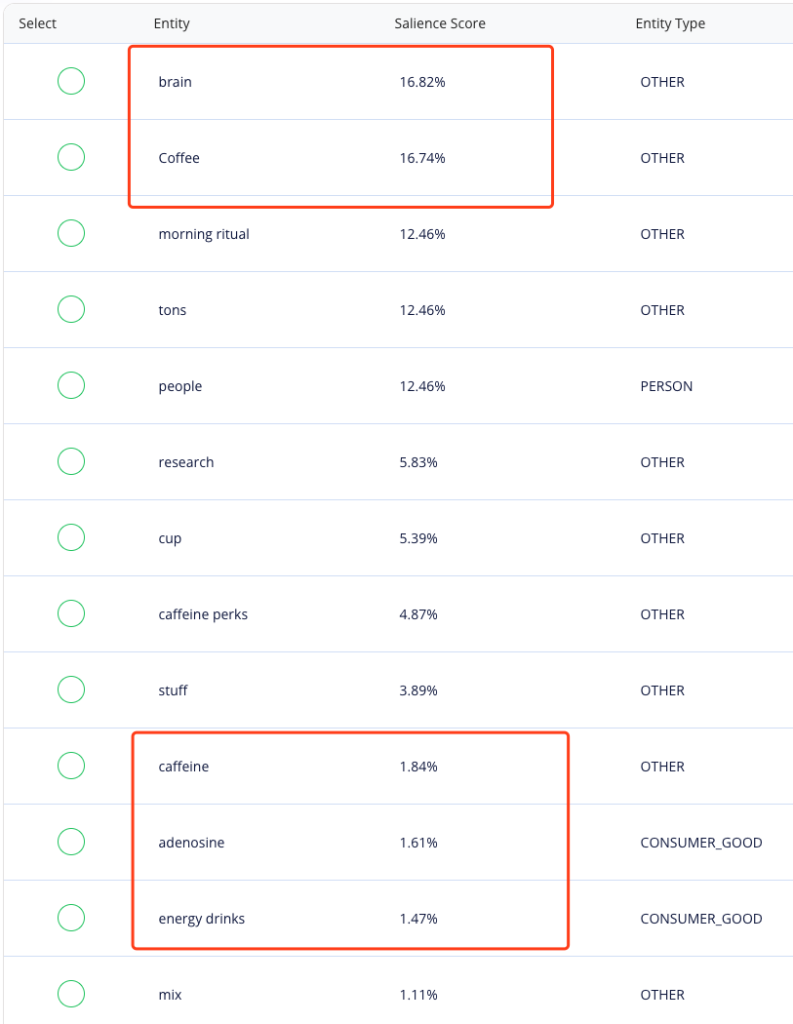
Coffee’s a go-to morning ritual for tons of people, and there’s solid research showing why: caffeine perks you up and sharpens your brain. A typical cup packs about 95 mg of caffeine, which works by blocking adenosine—the stuff in your brain that makes you feel sleepy. Compared to energy drinks, coffee gives you a smoother focus boost without dumping a bunch of sugar into the mix. That said, if you overdo it, you might feel your heart racing or get a bit jittery.
How Google’s NLP Sees It Now: This is where things get interesting. Google’s not just counting words anymore—it’s reading between the lines. It picks up that this article actually explains why coffee gives you energy based on semantic context, instead of just hammering the same point. It detects important entities and assiagn salience score to each of it, like:
"caffeine"→ A scientifically recognized stimulant with high salience score."adenosine"→ A neurotransmitter linked to drowsiness."energy drinks"→ A comparison entity that adds depth.
If linked to medical sources that Google deems as factual, such as Google Knowledge Graph or Wikipedia urls, Google boosts its ranking as authoritative content.
Google also sees that this content piece presents a balanced view with positive sentiment score, making it more trustworthy:

Main Features of Google NLP:
If you are still a little bit confused, I tweaked a few paragraphs grabbed from Apple Inc.’s Wikipedia page to make it easier to understand how to use Google NLP:
“Apple Inc. is an American multinational technology company headquartered in Cupertino, California, in Silicon Valley. It is best known for its consumer electronics, software, and services. Founded in 1976 as Apple Computer Company by Steve Jobs, Steve Wozniak and Ronald Wayne, the company was incorporated by Jobs and Wozniak as Apple Computer, Inc. the following year. It was renamed Apple Inc. in 2007 as the company had expanded its focus from computers to consumer electronics. Apple is the largest technology company by revenue, with US$391.04 billion in the 2024 fiscal year……..”
Now, imagine someone’s searching “What is Apple?”, Google NLP will figure out how above text fits the search query and intent in several ways:
Entity Recognition: Extracting and Categorizing Key Elements
Entity Recognition helps extract key elements from text by categorizing them into specific types based on Google’s semantic analysis of the overall context. Google NLP can identify several entity types, including PEOPLE, EVENTS, LOCATIONS, ORGANIZATIONS, and CONSUMER GOODS, and etc. You can find the full list of entity types in Google’s official documentation.
For example, given the sentence “Apple Inc. is an American multinational technology company headquartered in Cupertino, California, in Silicon Valley”, it will mainly extract*“Apple”, and “technology company”* and then determine that “Apple” refers to the technology company Apple inc instead of the fruit apple. This process is called Entity Linking, which is crucial for Google to understand human language in the first place.
By analyzing the entity recognition results of the above texts, you’ll typically receive detailed entity data, including salience scores (which we’ll cover later), Knowledge Graph URLs, and Wikipedia URLs, see the screenshot below:
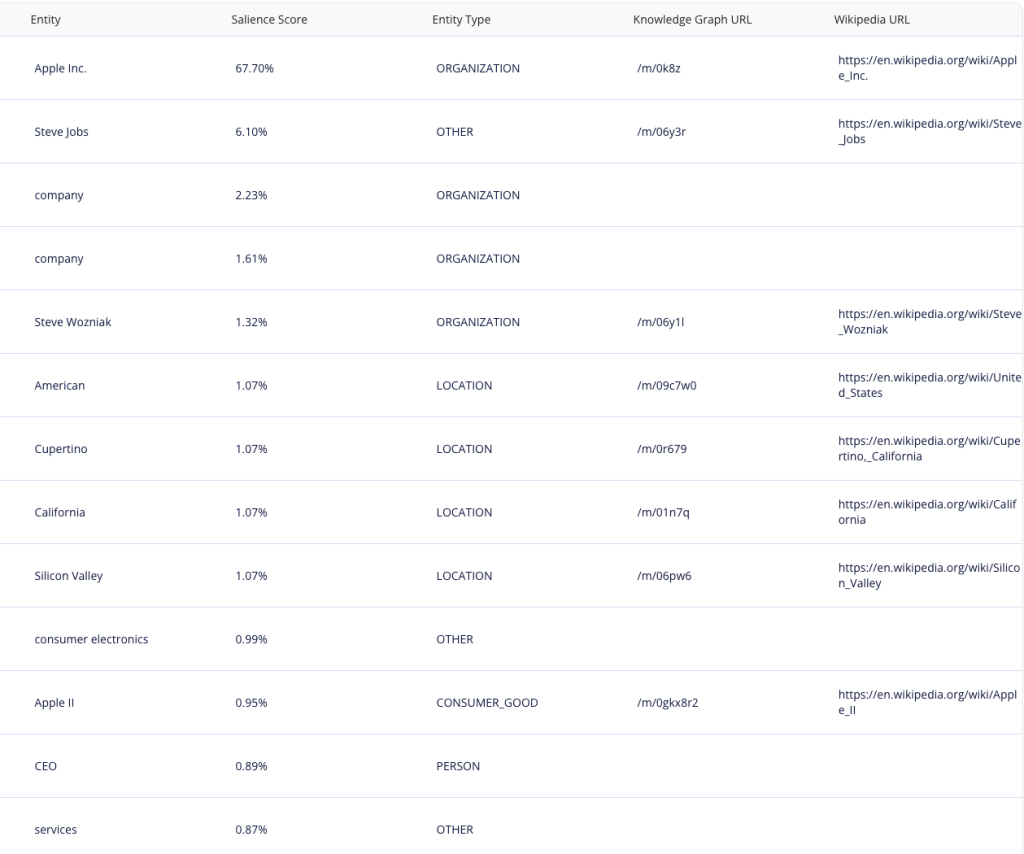
Take entity “Steve Jobs” and its Knowledge Graph mid “/m/06y3r” as an example, you could attach the mid to the query “https://www.google.com/search?kgmid=” to form the full Knowledge Graph url https://www.google.com/search?kgmid=/m/06y3r. This brings you a result page of Steve Job’s introduction along with his Knowledge Panel on the right-hand side, see the SERP screenshot below:
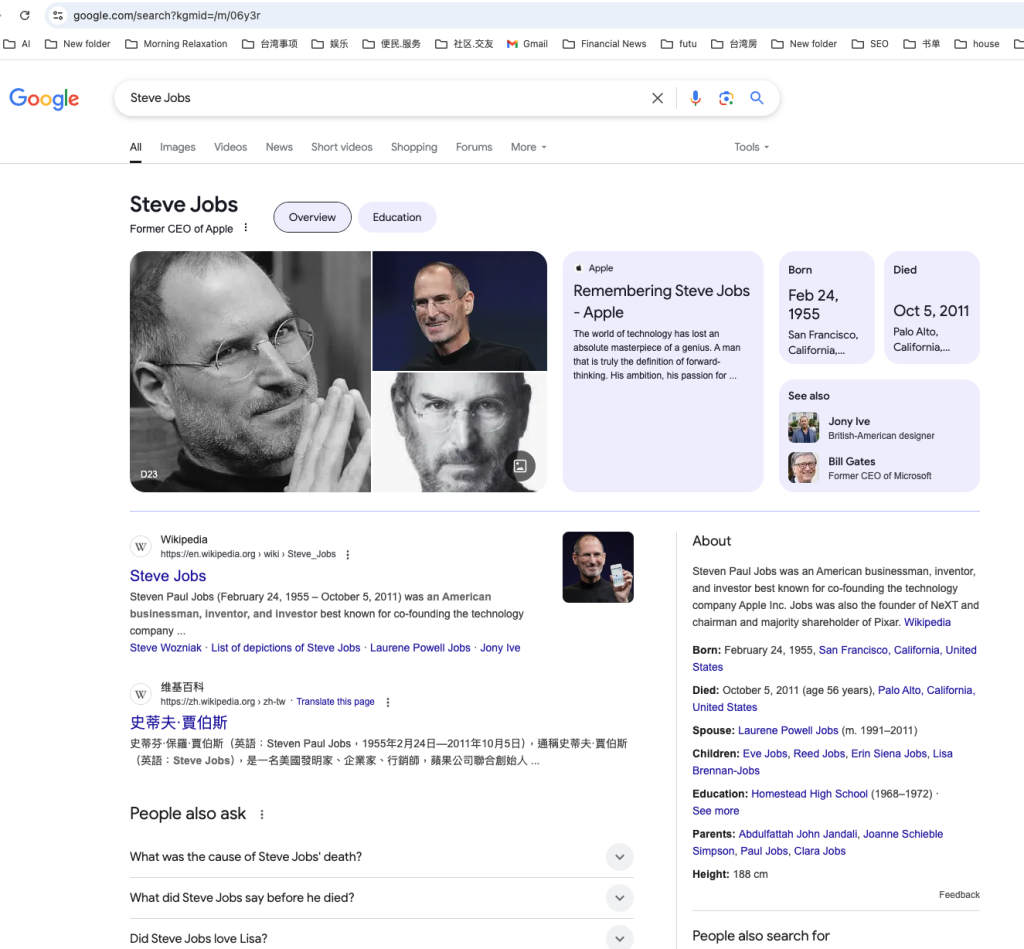
Google treats entities with a Knowledge Graph profile and/or a Wikipedia page as authoritative. The more recognized and authoritative entities identified in your content, the more in-depth and valuable Google perceives your article to be, which will positively impact rankings.
If you want to enhance your content’s credibility in Google’s point of view, try incorporating relevant and authoritative entities—especially those linked to both Wikipedia and Google Knowledge Graph. Since Knowledge Graph is generally formed with much information coming from Wikipedia and Wikidata, it would be highly recommended to always reference and link to Wikipedia pages in your content. This helps reinforce authority and feeds directly into Google’s structured entity database. you could learn more on How Wikipedia’s Role in Google Knowledge Graph.
If an entity only identified to have a Google Knowledge Graph but lacks wikipedia page**,** it’s still helpful, but the data is not always structured or transparant like Wikipedia, meaning it may not carry the same weight in terms of authority as Wikipedia page does.
Syntax Analysis: Prerequisite of Other Analysis
What is Syntax Analysis and Why It Matters
After recognizing key subjects like PEOPLE, LOCATION, PRODUCT through Entity Recognition, Google NLP takes things a step further—it analyzes how these entities relate to each other, much like a human would, using Syntax Analysis:
- Understanding Relationships – Google NLP doesn’t just recognize words, it looks at how they connect within a sentence to capture their true meaning.
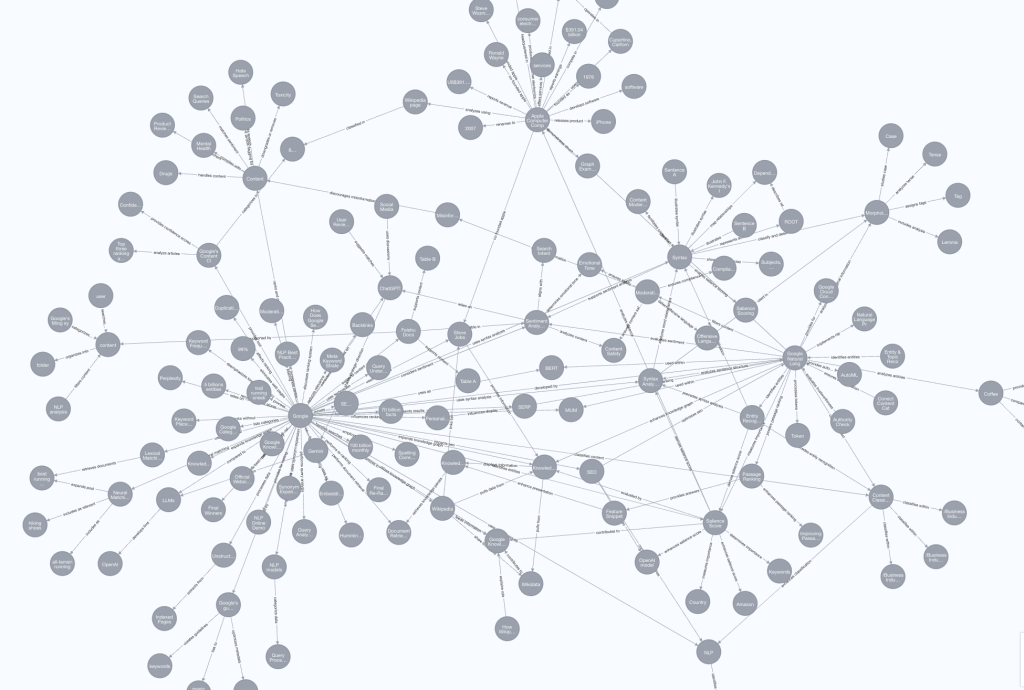
- Syntax & Readability – It structures a Knowledge Graph of word relationships, ensuring the article is well-organized, clear, and easy to read. Graph example below is formed from the Apple Inc wikipedia paragraphs, which delivers a really clean and organized structure for both human and search engine to understand the core entity and expanded topics.
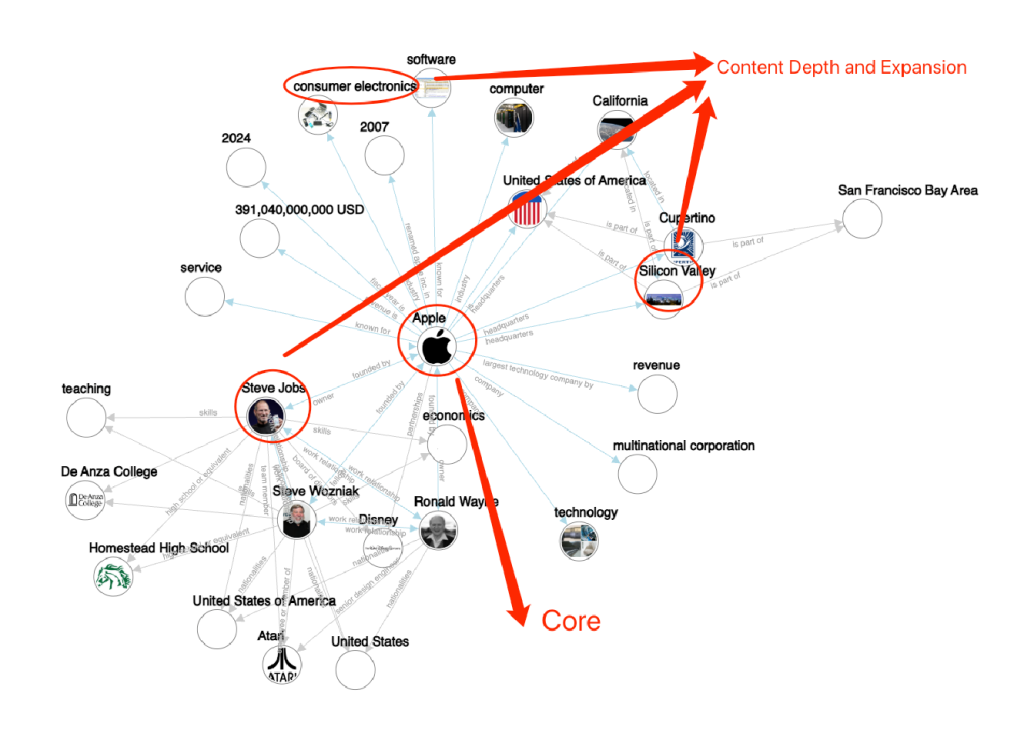
- Identifying the Core Topic & Depth – Instead of relying on outdated keyword tricks, NLP determines the most important entities (keywords) by applying Salience Score based on word relationships, ownership, tense, and context. It then evaluates whether the content fully answers the query with depth and supporting details. Let’s take a short sentence as a simple example to illustrate:
Sentence A:“I stole your money.”
Sentence B:“Your money was stolen by me.”
How Syntax Analysis interprets them differently:
| Sentences | Key Entity | Illustration |
|---|---|---|
| Sentence A | “I” | “I” is the subject and “your money” is the object. The action “stole” is directly linked to “I,” making “I” the primary entity in focus. |
| Sentence B | “Your Money” | “your money” becomes the subject, and “was stolen” is a passive construction, shifting the focus away from “me”. |
Even though both sentences convey the same idea, Google evaluates their syntax to determine the emphasis, relationships, tense, and keyword importance, which can influence search ranking and content relevance.
Detailed Breakdown of Syntax Analysis: Morphology and Syntax
Syntax Analysis uses two main method to understand the relationships among words: Morphology and Syntax.
To put it simply, Morphology tells Google what words are(noun, verb, current tense, or past tense), Syntax then connects words and determines which are most important in the sentence, they work together to map out relationships between words by assigning:
- ROOT word → The main verb or action in the sentence.
- Subjects, Objects, Modifiers → Which words depend on which.
- Dependency labels (like
dobj,nsubj,poss, etc.)
Below is an example of a dependency tree from John F. Kennedy’s Inaugural speech. The bottom layer represents Morphology, showing how each word is classified, while the top layer reveals the syntax structure—how words relate and depend on each other.
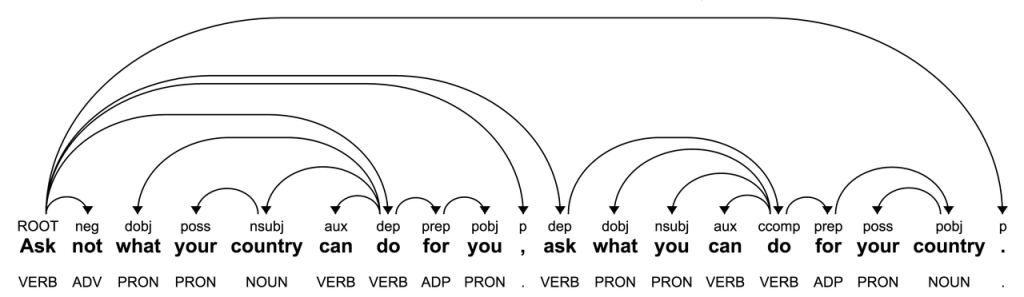
A Simple Breakdown:
Morphology answers:
- What kind of word is this?
- What is its base form?
- What is its tense, mood, and person?
Syntax answers:
- How do these words relate?
- What is the main subject, object, and verb?
- Which word is most important in the sentence?
Morphology:
Running Google NLP, you will receive the morphological information from the response’s partOfSpeech. You could find the full list of all fields responsed in Google Morphology and Dependency Tree. To name a few fields:
Token – The actual word extracted from the text.
- Example:
"running"
Lemma – The base form of the word.
- Example: Lemma of
"running"is"run".
Tag – The part of speech (POS) category assigned to the word.
- Example:
"NOUN","VERB","ADJ"
Case – Indicates if a word is nominative (subject), genitive (possessive), accusative (object), etc.
- Example:
"GENITIVE"(possessive case, e.g.,"John’s book").
Tense – The time frame of a verb’s action (past, present, future).
- Example:
"PAST"for"was running"
Number – Indicates if the word is singular or plural.
- Example:
"SINGULAR"for"apple","PLURAL"for"apples".
Person – Identifies if the subject is first-person (I, we), second-person (you), or third-person (he, she, they).
- Example:
"THIRD"for"he runs".
Mood – Indicates how the verb expresses action (indicative, imperative, subjunctive).
Example: "INDICATIVE" for factual statements, "IMPERATIVE" for commands.
Syntax:
You could find the full list of all Syntax fields from Google Morphology and Dependency Tree as well, to name a few:
ROOT – The main verb or core of the sentence that everything else depends on.
- Example:
"runs"in"The boy runs quickly."
Dependency (DEP) – Describes how words relate to each other (subject, object, modifier, etc.).
- Example:
"nsubj"(nominal subject) for"The boy"in"The boy runs."
Head Token Index – Shows which word another word depends on.
- Example:
"quickly"depends on"runs".
Negation (NEG) – Identifies negative words that alter sentence meaning.
- Example:
"not"in"He does not like apples."
Direct Object (DOBJ) – The receiver of the action.
- Example:
"apples"in"He eats apples."
Possessive (POSS) – Shows ownership relationships.
- Example:
"John’s"in"John’s book"
Prepositional Object (POBJ) – The object of a preposition.
Example: "school" in "She went to school."
Take the same sentence “Ask not what your country can do for you. Ask what you can do for your country” from above, we can break down the morphological details and syntax structure of each word. The final salience score—which measures a word’s importance in the overall context—was determined as follows:
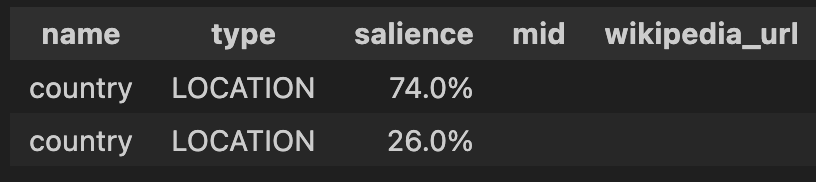
Why is “country” recognized as a key entity? Since:
- It’s a NOUN (from Morphology).
- It has possession (poss) showing importance: “your country.”
- It is part of the direct object (dobj), meaning it’s a main focus in the sentence.
How Sentence Structure Affects Salience Score
Under these circumstances, changing the structure of a sentence can significantly impact the importance of keywords and their Salience Scores. Let’s look at an example where two sentences convey the same meaning but are structured differently:
| Example A | Example B |
|---|---|
| “Apple Inc. is an American multinational technology company headquartered in Cupertino, California, in Silicon Valley. It is best known for its consumer electronics, software, and services. Founded in 1976 as Apple Computer Company by Steve Jobs, Steve Wozniak and Ronald Wayne, the company was incorporated by Jobs and Wozniak as Apple Computer, Inc. the following year. It was renamed Apple Inc. in 2007 as the company had expanded its focus from computers to consumer electronics. Apple is the largest technology company by revenue, with US$391.04 billion in the 2024 fiscal year.” | “In 1976, Steve Jobs, Steve Wozniak, and Ronald Wayne established a company initially known as Apple Computer Company. A year later, the business was incorporated as Apple Computer, Inc., focusing primarily on personal computers. Over time, it expanded its product range beyond computers, leading to a rebranding in 2007 as Apple Inc. The company operates out of Cupertino, California, a city within Silicon Valley. It generates significant revenue, with reported earnings of $391.04 billion in the 2024 fiscal year. Today, it is widely recognized for its consumer electronics, software, and services.” |
Now, let’s compare the analysis:
- Example A emphasizes Apple Inc. as the primary entity(with 63.9% Salience Score), making it the most important keyword in Google’s analysis.
- Example B shifts focus to people (Steve Wozniak with 11.7%) and computers(with 16.9% Salience Score), meaning Apple Inc. has a lower Salience Score.
If a user searches “What is Apple Inc.?”, ContextA is more likely to be retrieved by Google because it directly aligns with the search intent, reinforcing why sentence structure matters in SEO.
Result of Table A:
| Name | Type | Salience | MID | Wikipedia URL |
|---|---|---|---|---|
| Apple Inc. | ORGANIZATION | 63.9 | /m/0k8z | https://en.wikipedia.org/wiki/Apple_Inc. |
| company | ORGANIZATION | 5.2 | ||
| American | LOCATION | 4.8 | /m/09c7w0 | https://en.wikipedia.org/wiki/United_States |
| Cupertino | LOCATION | 4.8 | /m/0r679 | https://en.wikipedia.org/wiki/Cupertino,_California |
| California | LOCATION | 4.8 | /m/01n7q | https://en.wikipedia.org/wiki/California |
| Silicon Valley | LOCATION | 1.9 | /m/06pw6 | https://en.wikipedia.org/wiki/Silicon_Valley |
| company | ORGANIZATION | 1.8 | ||
| consumer electronics | OTHER | 1.7 | ||
| technology company | ORGANIZATION | 1.5 | ||
| computers | CONSUMER_GOOD | 1.1 | ||
| software | CONSUMER_GOOD | 1 | ||
| services | OTHER | 1 | ||
| consumer electronics | OTHER | 0.8 | ||
| focus | OTHER | 0.7 | ||
| Steve Wozniak | PERSON | 0.7 | /m/06y1l | https://en.wikipedia.org/wiki/Steve_Wozniak |
| Steve Jobs | PERSON | 0.7 | /m/06y3r | https://en.wikipedia.org/wiki/Steve_Jobs |
| Ronald Wayne | PERSON | 0.6 | /m/02z496 | https://en.wikipedia.org/wiki/Ronald_Wayne |
| revenue | OTHER | 0.5 | ||
| 1976 | DATE | 0 | ||
| 2007 | DATE | 0 | ||
| 2024 | DATE | 0 | ||
| US$391.04 billion | PRICE | 0 |
Result of Table B:
| Name | Type | Salience | MID | Wikipedia URL |
|---|---|---|---|---|
| computers | CONSUMER_GOOD | 16.9 | ||
| Steve Wozniak | PERSON | 11.7 | /m/06y1l | https://en.wikipedia.org/wiki/Steve_Wozniak |
| Ronald Wayne | PERSON | 11.7 | /m/02z496 | https://en.wikipedia.org/wiki/Ronald_Wayne |
| Steve Jobs | PERSON | 11.7 | /m/06y3r | https://en.wikipedia.org/wiki/Steve_Jobs |
| company | ORGANIZATION | 11 | ||
| Apple Computer Company | ORGANIZATION | 7 | /m/0k8z | https://en.wikipedia.org/wiki/Apple_Inc. |
| company | ORGANIZATION | 6 | ||
| Cupertino | LOCATION | 4 | /m/0r679 | https://en.wikipedia.org/wiki/Cupertino,_California |
| business | OTHER | 3.7 | ||
| product range | OTHER | 2.5 | ||
| rebranding | EVENT | 2.3 | ||
| earnings | OTHER | 1.7 | ||
| consumer electronics | OTHER | 1.2 | ||
| services | OTHER | 1.2 | ||
| software | CONSUMER_GOOD | 1.2 | ||
| revenue | OTHER | 0.8 | ||
| Silicon Valley | LOCATION | 0.5 | /m/06pw6 | https://en.wikipedia.org/wiki/Silicon_Valley |
| California | LOCATION | 0.5 | /m/01n7q | https://en.wikipedia.org/wiki/California |
| 1976 | DATE | 0 | ||
| 2007 | DATE | 0 | ||
| 2024 | DATE | 0 | ||
| $391.04 billion | PRICE | 0 |
Conclusion: The Role of Syntax in Google NLP and SEO
To sum up, by analyzing sentence structure through Syntax Analysis, Google can determine not just what words are present, but how they relate to one another:
- Google Understands Semantics Like a Human
Instead of relying solely on keywords, Google looks at sentence structure, word relationships, and contextual meaning. This allows it to better interpret search queries and retrieve the most relevant content, even when different words are used to express the same idea.
- Syntax is the Foundation for Other NLP Analyses
Syntax analysis serves as a prerequisite for Entity Recognition, Sentiment analysis, Content Moderation, and Salience Scoring. By mapping out dependencies within a sentence, Google determines which words are most important—helping it identify the main topic of an article and its relevance to a search query.
- Keyword Frequency and Placement No Longer Matter
If this sounds familiar, it’s probably because you’ve heard it a million times from coworkers or industry folks: “Stop stuffing keywords!” Well, here’s the real reason why. Traditional SEO tactics like keyword stuffing and placing keywords at the beginning of an article are now outdated. Google no longer ranks content simply because it contains the right words—it prioritizes well-structured, informative content that naturally aligns with search intent.
Understanding Salience Score in Google NLP
Since we have explicitly introduce Entity Recognition and Syntax Analysis from above, we have pretty much deliver the basic concept of what is Salience Score, to put it simply:
Salience score is Google’s way of measuring how important an entity is within a given text. It is a numerical value (ranging from 0 to 1) that represents the relevance of an entity to the overall content. The higher the score, the more importance that entity is to the main topic of the text.
One thing need to mention is that, Salience Score is not simply derived from Entity Recognition and Syntax Analysis, it also goes beyond that by evaluating external factors such as:
- Knowledge Graph & Wikipedia Authority
- If an entity has a Google Knowledge Panel or is listed on Wikipedia, it is considered more authoritative.
- Entities linked to external sources (like Google Knowledge Graph) often receive higher Salience Score.
- How Well the Entity Matches the Search Query
- If the entity closely matches what users are searching for, Google is more likely to assign it a higher Salience Score.
- Linked Mentions Across the Web
- If an entity is frequently referenced across multiple authoritative sources, Google reinforces its importance.
- Example: “Amazon is the largest online retailer in the world.”. Since “Amazon” is widely recognized, frequently referenced, and has a strong online presence, it will have a higher Salience Score in most contexts.
Content Classification: How Google Categorizes and Retrieves Content
What is Content Classification?
Google’s Content Classification plays a crucial role in how content are categorized and retrieved for ranking. You could think of it as a huge filing system to store and categorize billions of content. When user search for something, Google will firstly analyze the query and decide which filing folder to look from.

Google assigns web content into different “folders” based on tons of pre-defined categories, which are still expanding and evolving, you could find the full categories from Google Categories Doc. To name a few:
/Business & Industrial/Business Finance/Commercial Lending
/Business & Industrial/Business Finance/Investment Banking
/Business & Industrial/Business Finance/Risk Management
/Business & Industrial/Business Finance/Venture Capital
/Business & Industrial/Business Finance/Other
/Business & Industrial/Business Operations/Business Plans & Presentations
/Business & Industrial/Business Operations/Flexible Work Arrangements
/Computers & Electronics/Consumer Electronics/Audio Equipment
/Computers & Electronics/Consumer Electronics/Camera & Photo Equipment
/Computers & Electronics/Consumer Electronics/Car Electronics
/Computers & Electronics/Consumer Electronics/Drones & RC Aircraft
/Computers & Electronics/Consumer Electronics/Electronic Accessories
/Computers & Electronics/Consumer Electronics/Gadgets & Portable Electronics
The Role of Content Classification in Documents Retrieval Process
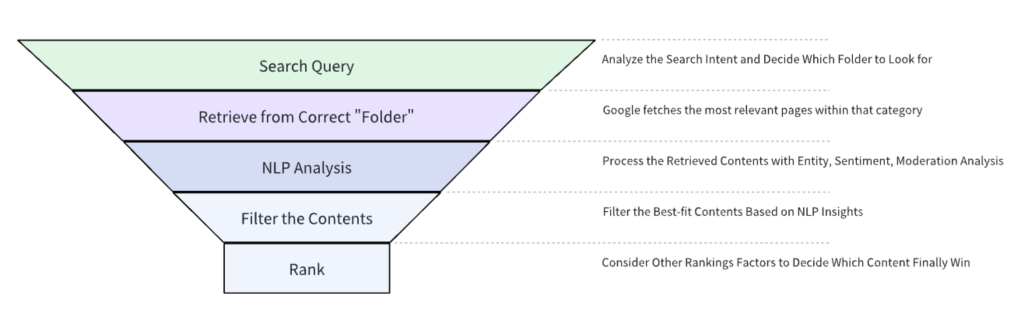
Google first figures out what the user is really looking for based on the query intent, then pulls content from the most relevant folders(categories). It runs NLP analysis to understand the content’s meaning, structure, and quality, filtering out the best matches. After that, other ranking factors come into play to decide which content deserves the top spot. You could tell that falling into the correct folder comes before almost everything, so make sure your contents are correctly categorized in Google’s filling system.
Ensuring Your Content is Placed in the Correct Category
Your content isn’t limited to just one category—it can fit into multiple ones. To increase the chances of it being placed in the most relevant folder, follow these steps:
- Run Google Content Classification on Your Own Content:
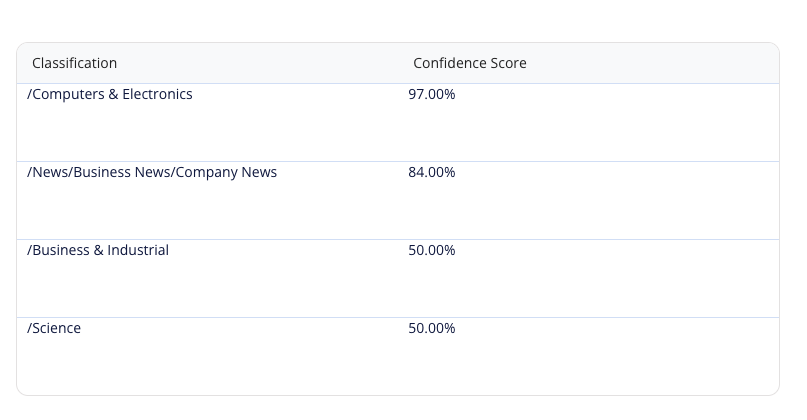
If you’re writing about finance and want to rank for some specific financial queries, structure your content in a way that aligns with Google’s finance-related categories. Using Google’s Content Classification tool to find out the confidence score from 0 to 1 (0 being the lowest, 1 being the highest). For example, running Apple Inc.’s Wikipedia page through Content Classification shows that we have a 97% confidence score to be categorized in the correct “/Computer & Eletronics” folder.
- Analyze Top-Ranking Content for Your Target Keywords:
Search for your target keyword on Google and analyze the top three ranking articles using Google’s Content Classification. Make sure your contents are in the similar folder as Top three ranks do. Top three rankings have already help you to filter out the best categories that Google prefers for this type of contents.
Sentiment and Moderation Analysis: Understanding Content Safety and Emotion
Both sentiment analysis and moderation assess the nature of content, but they focus on different aspects.
- What Are Sentiment and Moderation Analysis?
- Moderation Analysis: Ensuring Content Safety and Compliance
- It flags inappropriate, harmful, or offensive content. It identifies toxicity, hate speech, spam, or policy violations, see full list of moderation categories. If an article contains offensive language or misinformation, moderation tools help detect and filter out such content to maintain safe search results.
- Sentiment Analysis: Aligning Content with Emotional Intent
- It determines the emotional tone of the content—whether it’s positive, negative, or neutral. Google uses sentiment analysis to understand author’s prevailing emotional stance, as well as understands how users feel when they search. Though it doesn’t directly impact the ranking, Google would like to deliver the best match from the sentiment perspective. For example: User searches for: “Why is [brand] so bad?“, Google will prefer content that discusses negative sentiment, such as criticisms or drawbacks.
- Key Differences
- Moderation is about safety & policy compliance (toxic, harmful, misleading, drug etc).
- Sentiment is about emotion (positive/negative/neutral).
- Moderation Analysis: Ensuring Content Safety and Compliance
- Best Practices for Handling Moderation and Sentiment in Content
- Moderation: Keep Content Safe & Compliant
- Avoid using offensive or harmful language.
- Make sure your content follows Google’s content policies.
- If discussing sensitive topics (e.g., mental health, politics), ensure neutral and fact-based writing to avoid being flagged.
- Sentiment: Align with Search Intent
- Understand the emotional intent behind search queries.
- Write content that matches the sentiment users expect.
- Use sentiment strategically—for example, a product review site might highlight both positive and negative aspects to capture different search intents.
- Moderation: Keep Content Safe & Compliant
Summarization of the NLP Workflow:
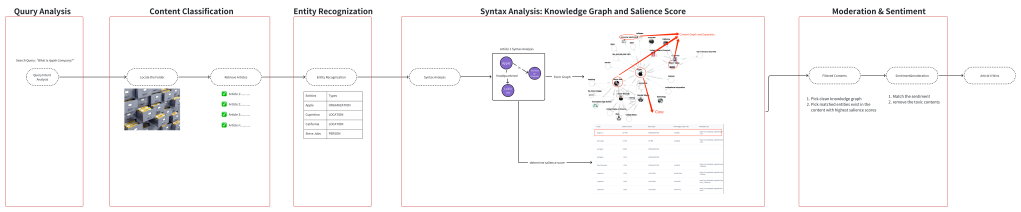
Finally, let’s summarize the whole NLP workflow to determine which articles get are more potentially to win:
- Query Analysis – Google Analyzes the search query, extracting meaning and sentiment.
- Content Classification – NLP Identifies the right category (“folder”) to pull relevant contents.
- Entity Recognition – Detects key entities (e.g., organizations, people, locations) out of all the retrieved relevant contents from the folders.
- Syntax Analysis – Identify if content are structured in a clean knowledge graph with clear relationships, as well as determining the most important entities based on the Salience Score.
- Moderation & Sentiment Check – Filters out toxic content and aligns sentiment with user intent.
- Final Winners – Weighs the best-matched contents for next step(ranking algorithm).
This step-by-step process ensures that Google retrieves, processes, and ranks content in the most relevant and meaningful way. However, content alone doesn’t guarantee a top ranking since there are additional complex factors to be considered such as Backlinks, Personalization, Duplications etc, we will dicuss it later in following section “How Does Google Search Rank System Work”.
That said, following the NLP best pratices boost your chance of being retrieved, indexed, and placed in the candidate pool, giving it the best shot at ranking higher.
Serious Questions About Google NLP and Search
Where Else Can NLP Models Be Used?
Google NLP is not a single, monolithic engine, but ranther complex models (BERT, MUM, etc) that would be used for various tasks across different stages, from quey understanding, semantic retrieval, context understanding, and re-ranking. Therefore, from the perspective of how Search itself works, NLP is “everywhere” under the hood. Here let’s me share two common scenarios:
- Passage Ranking/Direct Anwsers in Feature Snippet
Passage Ranking is introduced by Google in 2021 that allows search engine to rank specific passages or individual section ranther than ranking the entire page as a whole. Passage Ranking is powered by Google’s advanced Natural Lanaguge Processing(BERT) models to understand the context of specific passages within a larger context. Authors don’t need to make specific changes to their websites, while well-structured content is still important. Passage Ranking is still evolving, from merely understand the semantic context to retrieve the relevant passage to use user behavior for inferring passage relevence, you could learn more by continue reading Improving Passage Ranking with User Behavior Information
The NLP models in Passage Ranking is different from Google Natural Lanuage Processing tool to deal with content analysis (Sentiment, Moderation, Entity etc). The former uses internal advanced NLP models, while the latter uses third party application, however, both share similarities and reply on some shared techniques to analyze and extract meaning from text.
- Expand Knowledge Graph Database
By owning Knowledge Graph(mid) or Knowledge Panel no matter on your own domains, authorships, brands, organizations, or even yourself is crucial in SEO. Knowledge Graph plays as a screening method to narrow the content candidates in the later stage of re-rank in Google, domains, brand, or the author who published the contents with established Knowledge Graph will get more potential to rank higher. Knowledge Graph grows quickly, referenced from Google Knowledge Graph Wikipedia, Google has 5 billions entities recognized and stored by May 2020.
By mid-2016, Google reported that it held 70 billion facts and answered “roughly one-third” of the 100 billion monthly searches they handled. By May 2020, this had grown to 500 billion facts on 5 billion entities
However, by only relying on factual and structured data sources like Wikipedia and Wikidate is really time-consuming, since not every small-scaled brand has the manpower or budget to build up its own Wikipedia Page. Therefore, Google has officially annouce how they might use unstructured data (officially known as Knowledge Vault) to expand the Knowledge Graph, it’s likely that Google NLP plays an important role in understanding the entities, relationships, context of massive unstructured documents effectively, so the Knowledge Graph could grow quickly beyong just Wikipedia and Wikidata.
How Does Google’s Search Ranking System Work and Where Do NLP Models Fit?
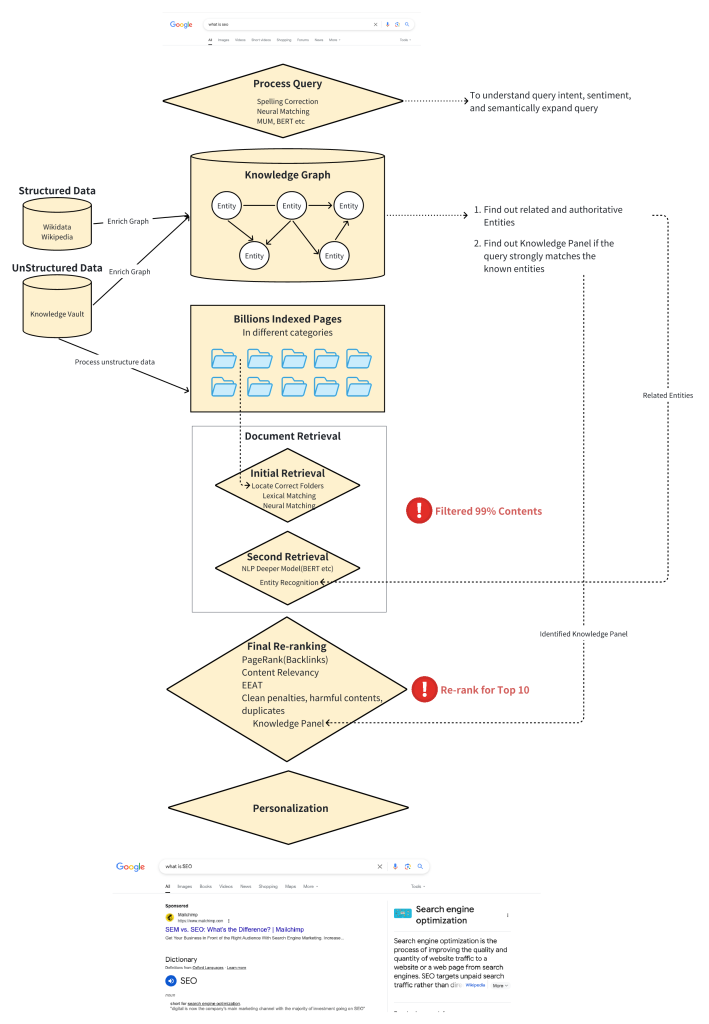
Google’s search algorithms are complex, and while some details are publicly shared through research papers and official documents, much of it remains proprietary. However, I will try my best to put them together in a comprehensive way of how Google processes, retrieves, and ranks content in SERP based on my experience. About 90% of this can be traced to official references.
- Query Understanding
When you type in a search query, Google uses Spelling Correction(Did you mean…?), Synonym Expansion(Recognizing different ways people phrase the same thing) and Neural Matching(Understanding the intent behind a query, even if the words don’t match exactly) to target and understand correct intent behind the queries. In addition, BERT/MUM algorithms are involved for context and possible entity detection as well in this phase
- Pre-Established Knowledge Graph
Google Knowledge Graph pulls structured data from Wikidata, Wikipedia. However, these databases aren’t updated fast enough, so Google uses unstructured data processed from billions of indexed pages to expand Knowledge Graph effectively. Though there are billions of unstructured index pages, those documents are highly possible categorized into different categories(folder) which is effective for locating and retrieving documents.
In this step, Google ties queries to known entities, retrieve Knowledge Panel(if exists), and inform re-ranking for recognized authoritative entities in later step.
- Document Retrieval(Two Stages)
- Initial Retrieval:
- Quickly find all potentially relevant documents from a massive index (billions of pages). When retrieving the documents from the correct folder, Google uses Lexical Matching(Inverted Index) to retrieve documents that match the query terms plus synonyms, expansion etc. Google has indicated that beyond Lexical Matching, they employ Neural Matching and embedding as well to expand the related documents. For example: Imagine you search for “best running shoes for trails” on Google. Lexical Matching: Google retrieves pages that contain exact words “best,” “running,” “shoes,” and “trails”. Webpages have the phrase “Top running shoes for trail running” are also good matches. Neural Matching and Embedding: This expands the pool of relevant documents, pulling in pages that talk about “hiking shoes” or “all-terrain running footwear”, even if they don’t contain the exact words “trail running sneakers.”
- Second Retrieval:
- After filtering down to thousands or hundreds of potential results, Google uses a more computationally expensive NLP model, often a transformer-based model such as BERT to compare the query and each candidate document in details to refine a smaller ste of candidates. If some previously recognized authoritative entities are existing in the documents, those documents are treated with higher credibility.
By the end of this stage, 99% of web pages get eliminated, leaving only the most competitive, high-quality results.
- Final Re-Ranking:
At this point, Google has a strong list of candidates, but it still has to determine the order in which results appear. This step considers additional factors such as backlinks(PagerRank Algorithm), Site Authority, Knowledge Panel, EEAT signals, and User Experience(page speed, mobile-friendly, Core Web Vitals etc) to re-rank the documents, in the mean while, tons of documents are filtered by spam checks, duplication checks, etc.
- Personalization
Adjust for user location, language, and (to a limited extent) user’s past behavior if relevant.
- SERP Presentation
Display top results with possible featured snippets, knowledge panels, or other specialized search features.
After getting to know the whole process, you could tell that NLP models aren’t just a single, standalone tool used at one stage—they are woven throughout the entire search process. From query processing and categorizing unstructured data to retrieving documents and final ranking, NLP plays a crucial role in refining search accuracy and relevance at every step.
Should I Abandon the Old-School Meta Keyword Strategy?
The short anwser is NO. Though oogle’s advanced understanding of search intent allows it to match queries to relevant content even when the exact keywords aren’t present., that doesn’t mean keywords are irrelevant. As we discussed earlier on how Google retrieves and present results in SERP, Google uses Lexical Matching to retrieve all the relevant documents from the indexed categories.
What is Lexical Matching? It is an inverted index maps terms (words or tokens) to the list of document IDs in which they appear. Let’s explain it in a quick example:
Imagine we have three documents in a search engine’s database:
Documents:
Doc 1:“Apple releases a new iPhone.”
Doc 2:“Samsung unveils its latest phone.”
Doc 3:“Apple and Samsung are competing in the smartphone market.”
If a user searches “Apple smartphone”, the search engine will quickly check the inverted index and find:
“Apple” appears in Doc 1, Doc 3
“smartphone” appears in Doc 3
Doc 3 is the best match because it contains both terms.
Yet the most important thing should always be your content depth and topic expansion to cove related concepts and providing comprehensive information., instead of only focus on exact keywords and supportive keywords.
Google Search Uses Complex Algorithms—Why Not Fully Switch to LLMs?
Google does use LLMs like Gemini(formerly BARD) and has integrated BERT, MUM, HummingBird and other algorithms. However, it doens’t completely abandon NLP techniques because:
- Efficiency and Speed: LLMs like Gemini or OpenAI are extremely computationaly expensive and inefficient. Running an LLM-based ranking system for billions of searches per second would be too costly and slow compared to Google’s current NLP-based ranking system
- Factual Validation: LLMs, in a lot of occassions, would make things up(hallucination) instead of give credible and authoritative anwsers. Users expect to receive accurate and reliable information, this is why NLP-based ranking system prioritizes fact-based indexing such as Wikipedia or Official Websites.
- Scalability: Google NLP could efficiently crawl, categorize, and rank billions of web pages, however, LLMs’ main focus is not to expand its database to store substantial and massive pages.
Besides, currently most of the prevailing LLM chat tools like Perplexity and ChatGPT are heavily rely on Google Search Engine results to retrieve the most accurate contents, and present them in their own chat tool, to find out more continue reading How ChatGPT Recommends Products: The Hidden Logic Behind AI Suggestions.
How to Use Google NLP Tool
How to Use Google NLP API
Google NLP provides the API for you to use in several ways, depending on your needs:
- Google Cloud Console: Google provides a web-based interface for managing and testing the API using its developer console. If you are looking for more advanced capabilities, you can also explore AutoML to train and deloy your own custom NLP models
- Client Libraries: You could interact with Google NLP using the client libraries, see the Quickstart Guides for step-by-step instructions
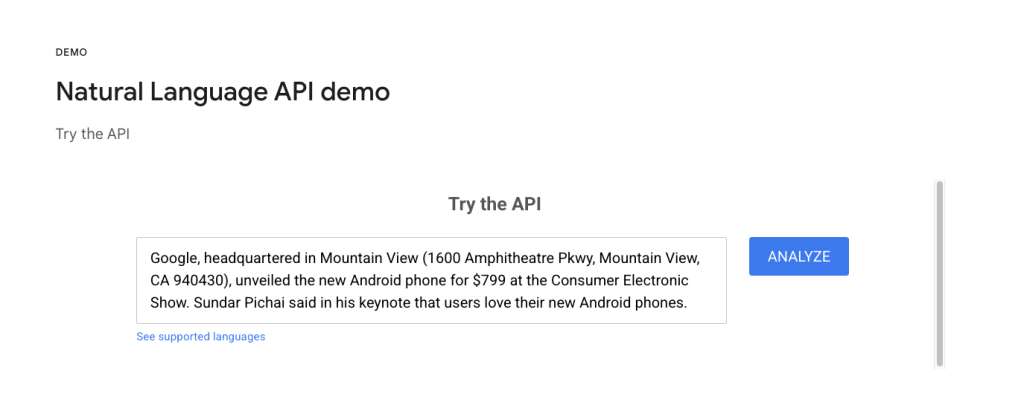
- Webpage Demo: If you are looking for a quicker, no-code way to use Google NLP, Google provides the NLP Online Demo online that you could try it immediately
Supported Languages
The list of supportivate languages are varied based on the specific features (e.g., Sentiment Analysis, Entity Recognition, Content Classification, Syntax Analysis, and Moderation). You could see the full list of supportive languages on different features. Google currently supports following languages for Sentiment Analysis:
Arabic, Chinese (Simplified), Chinese (Traditional), Dutch, English, French, German, Indonesian, Italian, Japanese, Korean, Portuguese (Brazilian & Continental), Spanish,Thai, Turkish, Vietnamese…..
Limitations of NLP Online Demo
While the Google NLP webpage demo is great for quick testing, there are some important limitations to keep in mind:
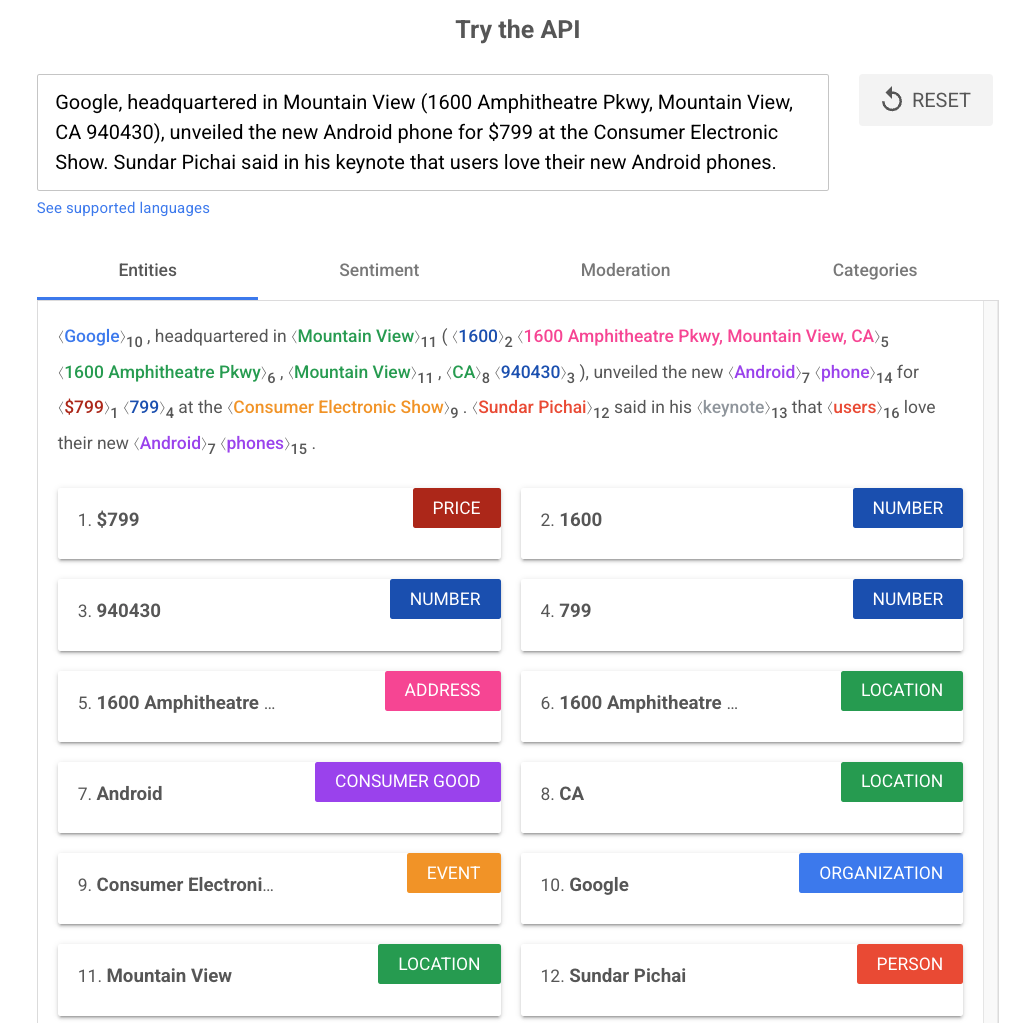
- Feature Restrictions: As seen in the demo interface, only a few core features are available. More advanced capabilities like Syntax Analysis and Morphology processing are missing.
- Text Length Limitations: There may be restrictions on input length or a time limit for each trial session.
- Inconsistent Outputs: Since the demo may not always run on the latest NLP model, its results may slightly differ from those obtained via the full API.
- Limited Flexibility: If you want to compare your content against top-ranking pages for sentiment, moderation, entity recognition, or syntax, or batch process your articles in bulk, the demo cannot fullfill your demands.
Other Tool to try on
In you need a scalable solution, there is an third-party NLP tool that integrate both Google NLP API as well as OpenAI model to provide more features:
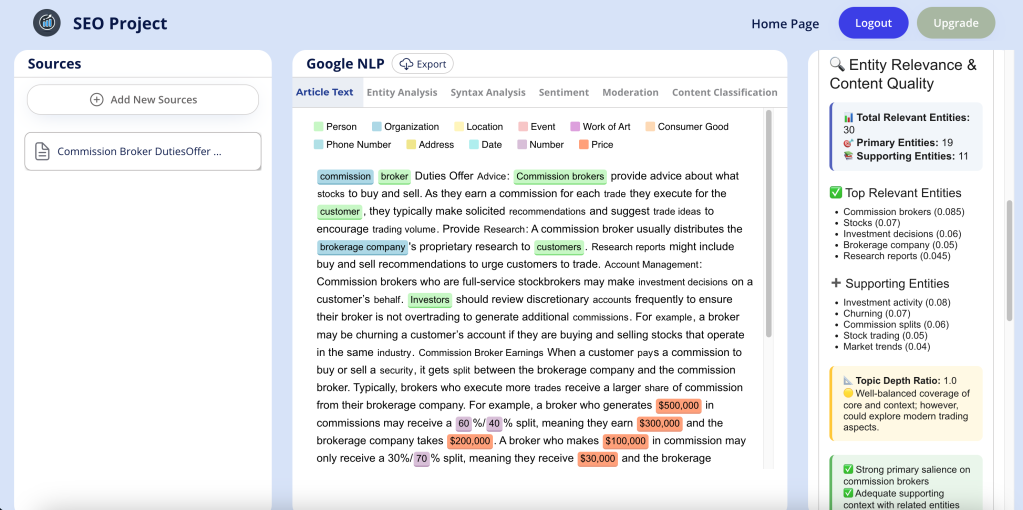
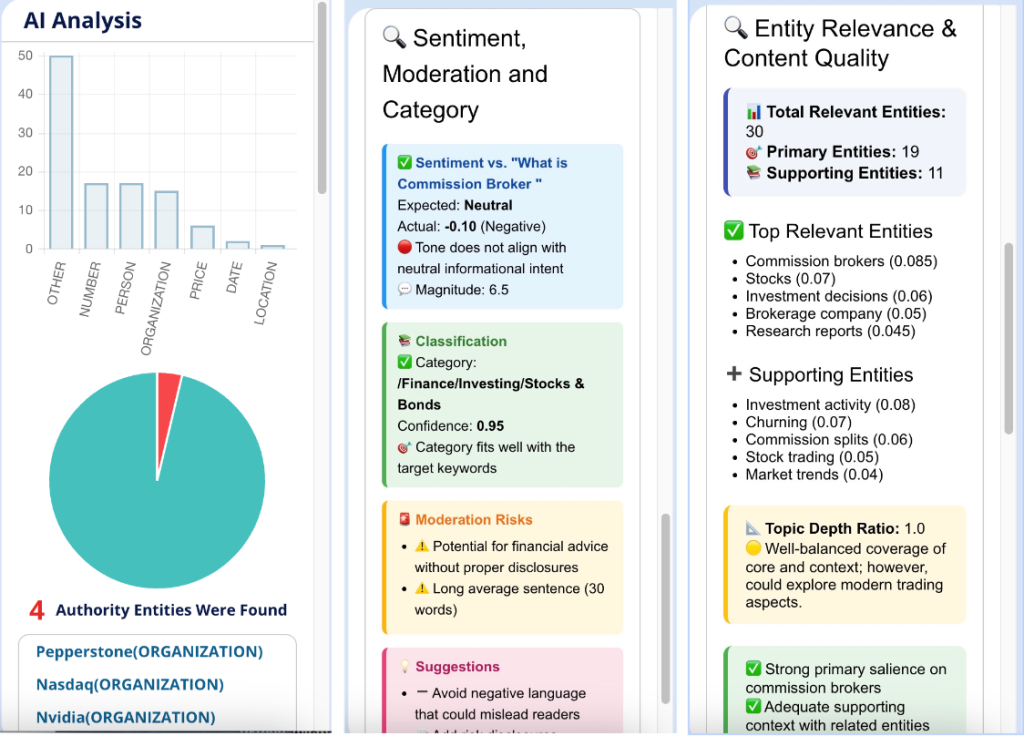
- Immediately boost the Salience Score of key entities in your content without altering your oroginal content structure, it’s perfect to improve the content relevance.
- Optimize your article’s sentiment sentence by sentence, ensuring the overall tone aligns with your target ranking goals.
The best part is, this tool is current free, feel free to explore it and see how it can enhance your SEO and content analysis workflow.
Bonus: Knowledge Graph For Current Article
Check out the Knowledge Graph for current article:
More on Entity Analysis
Proven Google NLP Strategies That Boosted SEO Rankings
Look, if you're still thinking about SEO the way we did five years ago, you're already behind. Google isn't just matching keywords anymore – they're actually understanding what people mean when they…
Text Sentiment Analysis with Python: A Comprehensive Guide
In today's data-driven world, understanding public opinion has become crucial for businesses, researchers, and organizations. Text sentiment analysis with Python offers powerful capabilities to…
How text classification powers smarter sentiment analysis
Sentiment analysis and text classification are foundational techniques in natural language processing (NLP) that help systems understand and categorize human language. While sentiment analysis…
Top Sentiment Analysis Tools to Compare in 2025
A text sentiment analyzer is a tool designed to interpret and classify the emotional tone behind a body of text. Whether it's a product review, a customer email, or a tweet, sentiment analysis tools…
Text Sentiment Analysis Guide: Meaning, Methods & Use Cases
Text sentiment analysis is a natural language processing (NLP) technique used to determine the emotional tone behind a body of text. By analyzing text data, sentiment analysis tools help identify…