%20--%3e%3cline%20x1='32'%20y1='14'%20x2='54'%20y2='22'/%3e%3cline%20x1='32'%20y1='14'%20x2='54'%20y2='42'/%3e%3cline%20x1='32'%20y1='50'%20x2='54'%20y2='22'/%3e%3cline%20x1='32'%20y1='50'%20x2='54'%20y2='42'/%3e%3c/g%3e%3c!--%20accent%20edges%20from%20highlighted%20middle%20node%20--%3e%3cg%20stroke='%232c7be0'%20stroke-width='1.4'%20stroke-linecap='round'%3e%3cline%20x1='32'%20y1='32'%20x2='54'%20y2='22'/%3e%3cline%20x1='32'%20y1='32'%20x2='54'%20y2='42'/%3e%3c/g%3e%3c!--%20nodes%20--%3e%3cg%20fill='%230a0a0a'%3e%3ccircle%20cx='10'%20cy='14'%20r='3.2'/%3e%3ccircle%20cx='10'%20cy='32'%20r='3.2'/%3e%3ccircle%20cx='10'%20cy='50'%20r='3.2'/%3e%3ccircle%20cx='32'%20cy='14'%20r='3.2'/%3e%3ccircle%20cx='32'%20cy='50'%20r='3.2'/%3e%3ccircle%20cx='54'%20cy='22'%20r='3.2'/%3e%3ccircle%20cx='54'%20cy='42'%20r='3.2'/%3e%3c/g%3e%3ccircle%20cx='32'%20cy='32'%20r='4.4'%20fill='%232c7be0'/%3e%3c/svg%3e)
Do You Know You Can Get AI to Recommend You More?
Cited vs. Just Mentioned: What AI Citation Actually Changes for Your Brand
Most brands see their name show up in a ChatGPT answer and call it a win. We get it — it feels like arriving. But a name the model pulled from memory is not the same as a citation, where the model pulls your live page in as a source. And the gap between the two is bigger than it looks.
Here's what stopped us cold. On one set of high-intent comparison questions, the AI assistants mentioned and recommended our client — a B2B SaaS brand — most of the time. By "mention rate" we mean the share of answers, across the same prompts run repeatedly on each model, where the brand was named or recommended in the text: Claude did it about 70% of the time, ChatGPT about 65%. The brand was clearly in the model's head. Then we looked at the citations — the source list under each answer. The brand ranked #19 out of the top 20 most-cited domains for these queries. Put plainly: of all the websites these AI answers pulled in as sources, ours was almost the last one they reached for — and most of the time we weren't cited at all. A direct competitor was cited about ten times as often. So the AI liked them out loud, but wouldn't put them on the reference list. We've named this before — the mentioned-but-not-cited gap; this piece is about what closing it is actually worth.
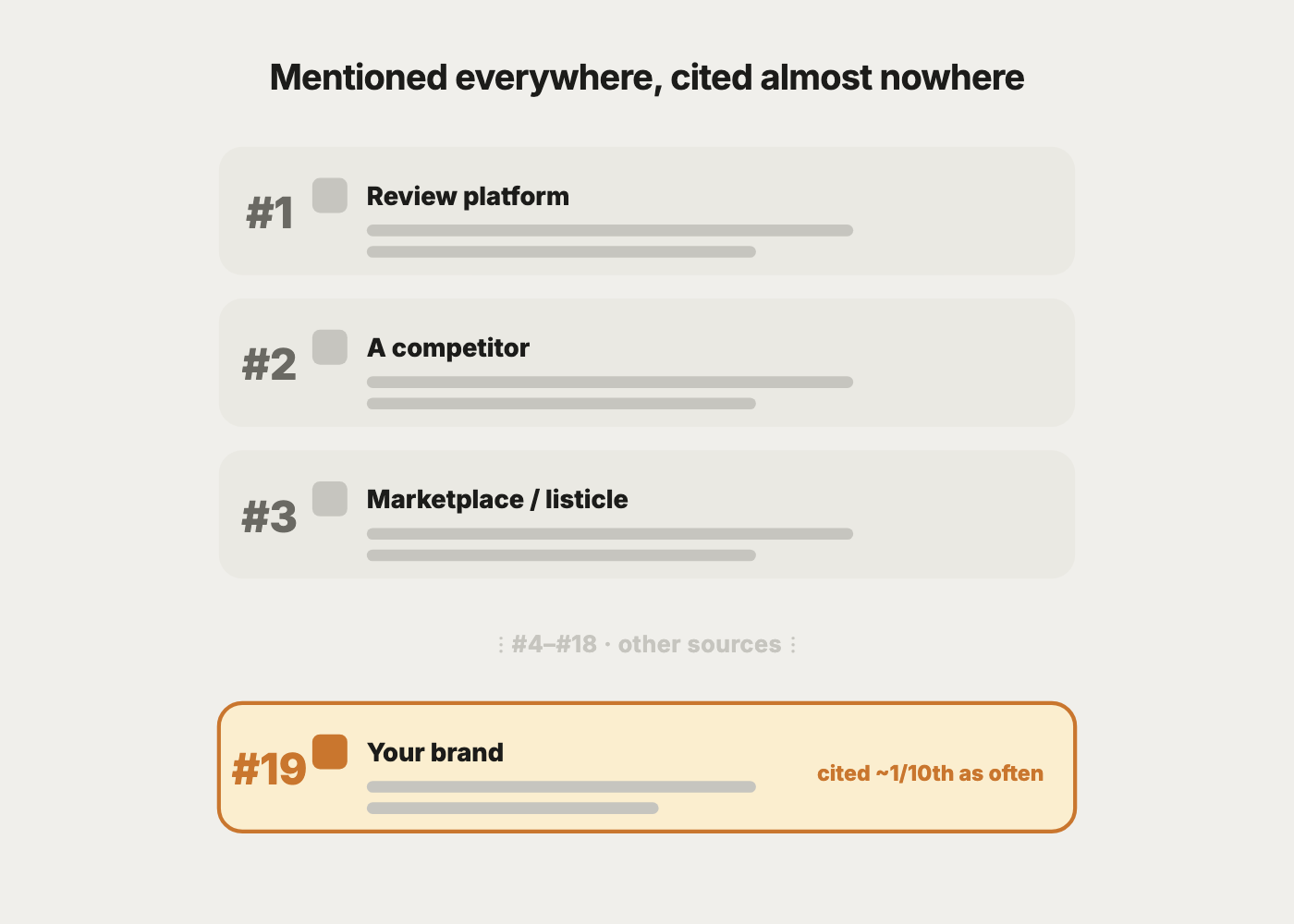 Where the brand lands among the sources these AI answers actually cite (labels anonymized; only rank is shown). A review platform and a competitor sit up top; our brand is buried at #19 of 20 — cited roughly a tenth as often.
That gap matters, because being cited — not just mentioned — is what actually changes how the model talks about you. We measured it across 500 real AI answers. Here's what we found.
How we measured "sentiment," "visibility," and "lift" (read this first)
Three plain definitions, because the rest of this piece leans on them:
- Sentiment score (0–100): how favorably a model talks about the brand inside its answer.
- Visibility score (0–100): how prominently and positively the brand shows up in that answer.
- Lift: the gap between two groups. When we say "+12.7 sentiment," we mean the cited group averaged 12.7 points higher than the not-cited group.
The setup: we took 500 AI answers to the same set of comparison prompts, fanned out across every major answer engine, then split them into two piles — answers that cited our client's page as a source and answers that didn't. Then we compared the two piles. Same prompts, so it's apples to apples.
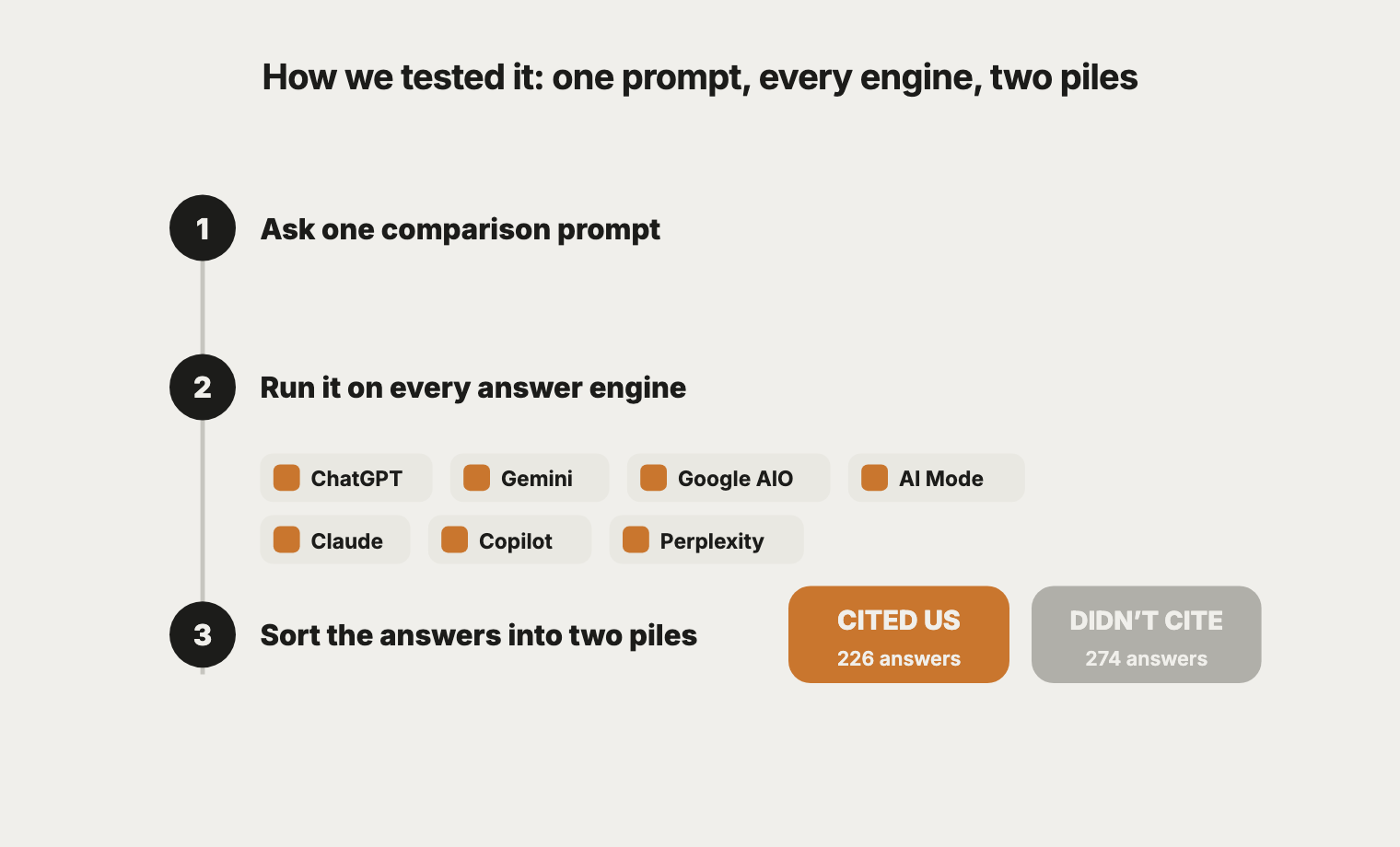 The test in three steps: ask one comparison prompt, run it on every answer engine (ChatGPT, Gemini, Google AI Overviews, AI Mode, Claude, Copilot, Perplexity), then sort the 500 answers into two piles — cited us (226) vs didn't (274). (Engine names shown as slots; real logos can be dropped in.)
One honest note: this is an observed comparison, not a lab experiment. Cited pages might differ in other ways too. But the pattern is strong and consistent, and the practical playbook it points to is the same either way.
What actually changes when an AI cites your brand
Three things move together, and they all move in your favor.
Sentiment goes up about 20%. Cited answers averaged a sentiment of 76.7, versus 64.0 when the brand wasn't cited — a +12.7-point lift. Visibility moved almost as much: 88.5 vs 74.5, a +13.9 lift.
Here's what that looks like in practice. When the brand wasn't cited, a typical answer stayed generic — "there are several tools in this space; some users find [Brand] a bit pricey" — a lukewarm line pulled from the model's memory. When the brand was cited, the model rephrased our own page in its own words and the tone flipped: "[Brand] stands out for accurate delivery estimates and branded tracking, with strong analytics for growing teams." Notice the model isn't quoting us verbatim — it's paraphrasing the cited source — but because our page is the source it's paraphrasing, the description lands warm and specific instead of vague. Trace any warm answer back and you'll usually find one of our URLs in its reference list.
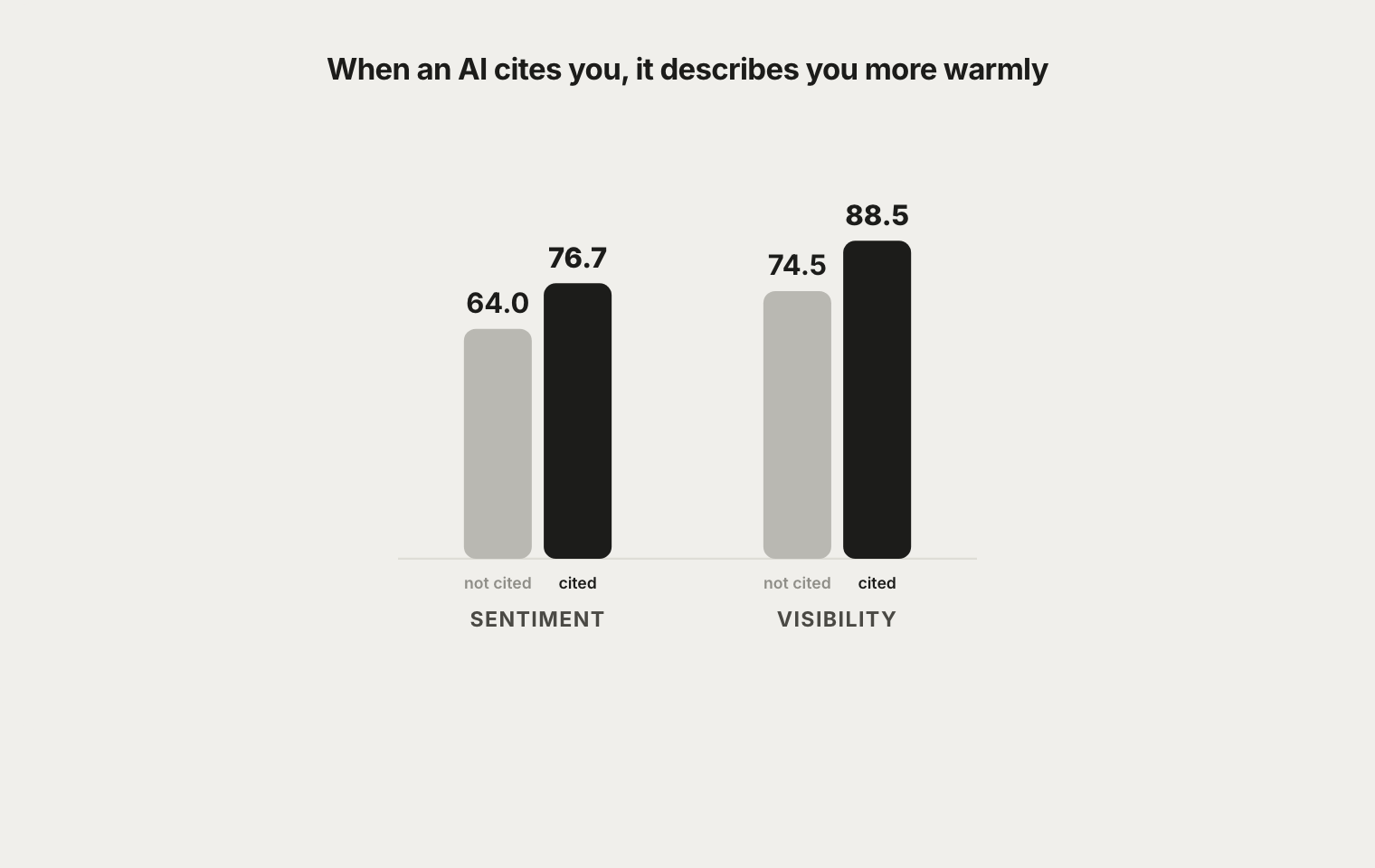 Cited answers scored higher on both sentiment and visibility (0–100 scale). Light bars = answers that didn't cite us; ink bars = answers that did.
And it shows up in real search behavior. Clicking an AI citation is rare, so a person who sees you in an AI answer usually does the next logical thing — searches your brand name. We watched for exactly that. On branded queries landing on the homepage, the ranking position stayed flat (around 1.6–1.9), but click-through rate climbed from 3.7% to 4.9% — a 32.4% jump. Position flat, clicks up: that's new demand created by AI exposure, not a ranking artifact.
Is the win from how many citations, or from being cited at all?
Answer: it's the 0→1 switch, not the volume. Answers that cited a single URL averaged 82.8 sentiment; answers that cited two or more averaged 71.1 (a correlation of −0.36 — more citations trended slightly cooler). So the move is to earn one clean citation, not to stuff an answer with links.
Is the lift the same across every AI engine?
At first glance, no — the sentiment lift looked like a ChatGPT-family effect: +9.8 points (83.9 cited vs 74.1 not-cited), and flat on Copilot. But once you ask why, the more useful answer is the opposite: the lift is probably the same across engines — what differs is which search index each model can even find you in.
Here's the mechanism, and it's the single most important thing in this piece. Different assistants read from different search backends: ChatGPT cites URLs indexed by Bing; Claude and Gemini (and Google's AI surfaces) cite URLs indexed by Google. When our comparison cluster went live, Bing indexed almost all of it — but Google had indexed only about 30%. So ChatGPT could find and cite our pages, and its sentiment rose; the Google-backed models mostly couldn't cite us at all, so there was nothing to lift. It read as a "ChatGPT effect," but it was really an indexation-coverage effect. As our Google indexation climbs, the same lift starts showing up on Gemini and the rest of the Google family too.
So the takeaway isn't "optimize for ChatGPT." It's: get indexed in both Bing and Google, and the citation lift generalizes across engines.
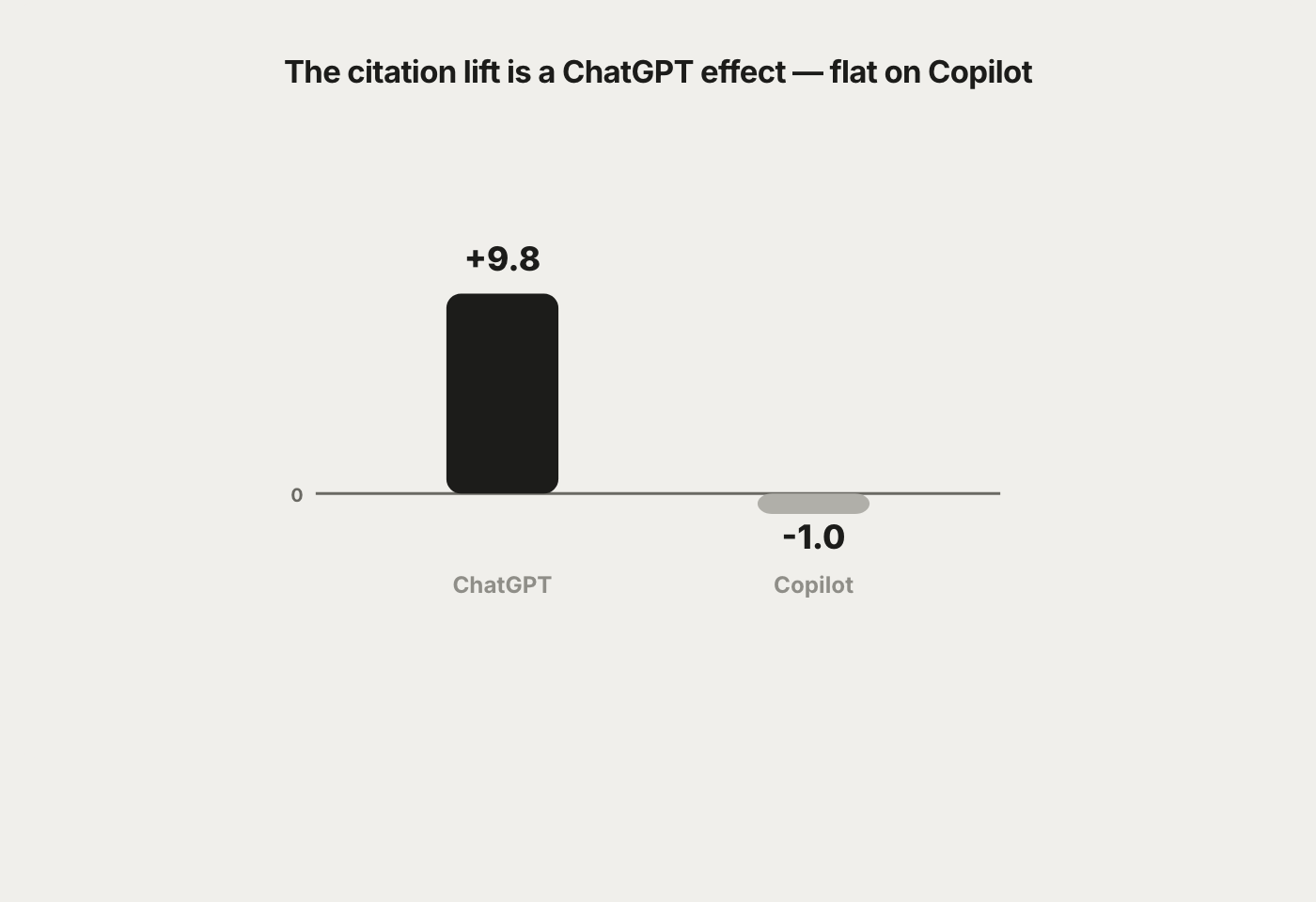 Observed sentiment lift (cited minus not-cited), in points: ChatGPT +9.8, Copilot −1.0. Read it with the caveat above — this mostly tracks which pages each engine had indexed and could cite, not an inherent engine preference.
What's the risk if you're not cited?
Not being cited isn't just "a slightly cooler tone." Two concrete things go wrong.
One: you get dropped from the answer entirely. Non-cited answers left the brand out 15.7% of the time, versus 4.4% when the brand was cited — 3.6× more often. That's also why our sentiment gap widens once you count those omissions: ignoring them, the lift is a modest +4.4; counting the times the brand vanished, it's +12.7. The real damage lives in the answers where you simply aren't there.
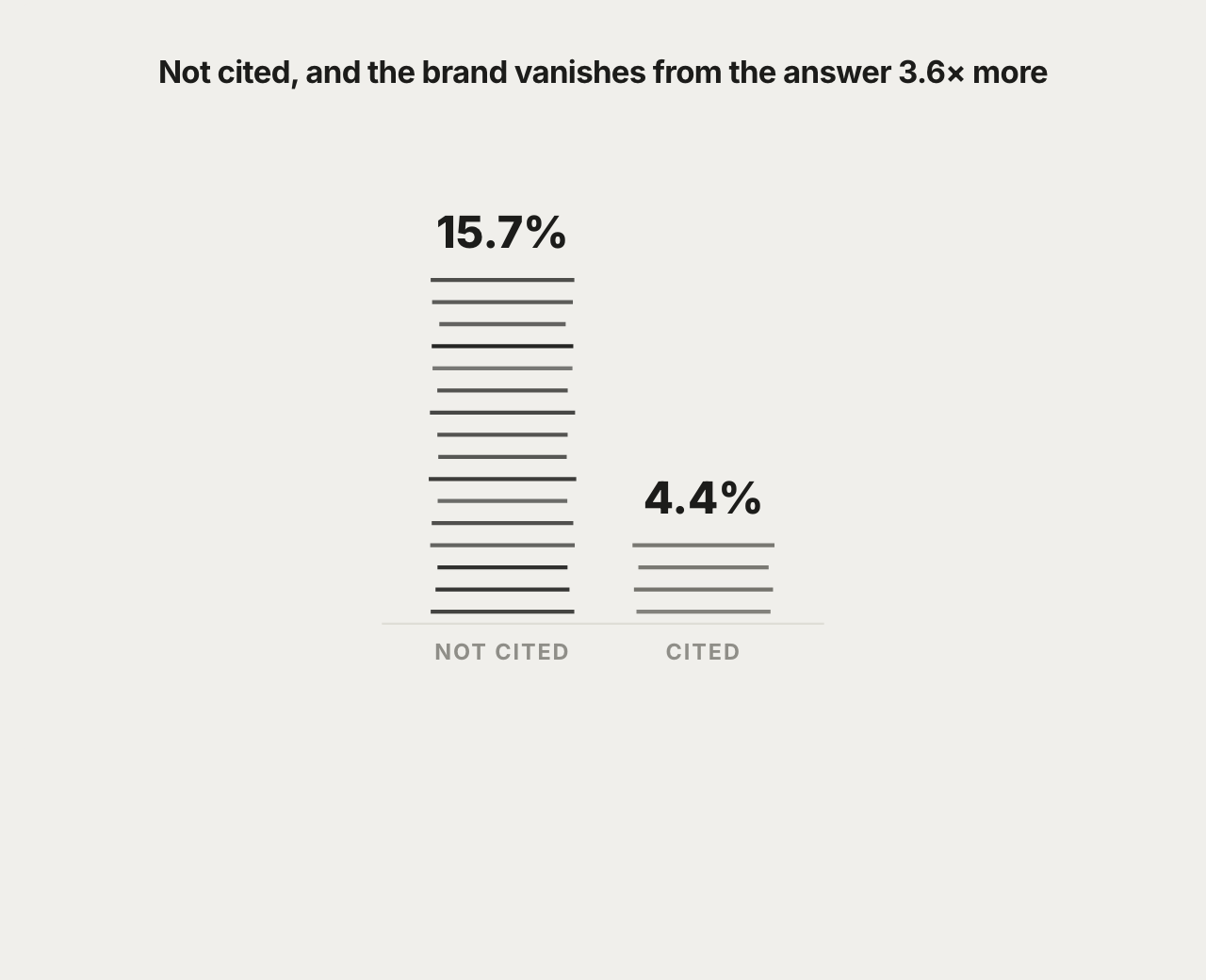 Each rung is roughly 1% of answers that dropped the brand entirely. Not-cited answers omitted the brand 3.6× more often than cited ones.
Two: your story gets written by other people's content. AI doesn't quote you verbatim — it rephrases, translates, and synthesizes whatever sources it pulled into one answer. If the pool it draws from is dominated by third-party complaints or thin reviews, that becomes your narrative — and with none of your own pages cited, you have no rebuttal in the answer. The same question can swing warm or cold purely on which sources the model happened to index.
So how do you actually get cited?
Citation is the last mile of a chain, and every link is a real job. It's not a switch you flip. (For the wider playbook this sits inside, see our guide to AI search optimization.)
1. Get indexed — the hard gate. An AI can only cite a page its search backend has actually indexed. In one cluster we audited, Google had indexed just 31% of the pages (28 of 90). Those indexed pages were cited 79% of the time, versus 31% for the non-indexed ones. And engines see different pages: Bing had indexed 92% of that same cluster. So ChatGPT and Copilot (Bing-backed) could cite pages that Gemini and Google's AI Overviews (Google-backed) simply couldn't.
2. Build the right clusters. Organize content into clusters aimed at real buyer personas and genuine demand — the questions people actually ask — not whatever you feel like publishing.
3. Rank the pages. Ranking is the entry ticket to live-search citation. Pages parked at non-branded positions 15–30 never get retrieved, so they can't be cited no matter how good they are.
4. Structure content the way each AI cites. Each engine rewards different signals. In our audit, adding an FAQ section made content 10.75× more likely to be cited by Claude; naming specific product features explicitly earned 9.9× on ChatGPT (in our case those were post-purchase notification features — that exact signal is industry-specific, so read it as "name the concrete features your buyers actually search for," not literally "add notifications"); geographic detail was worth 13.7× on Google AI Overviews but hurt on the others.
The real lesson: there is no universal checklist you can bolt onto every page. What gets cited is specific to the platform, the industry, the page type, and the topic. The only reliable method is to pull the pages each AI currently cites for your target topic and reverse-engineer what they have in common — then match it. Specific pricing happened to help across all three engines in our data, but treat even that as a hypothesis to verify per topic, not a fixed rule.
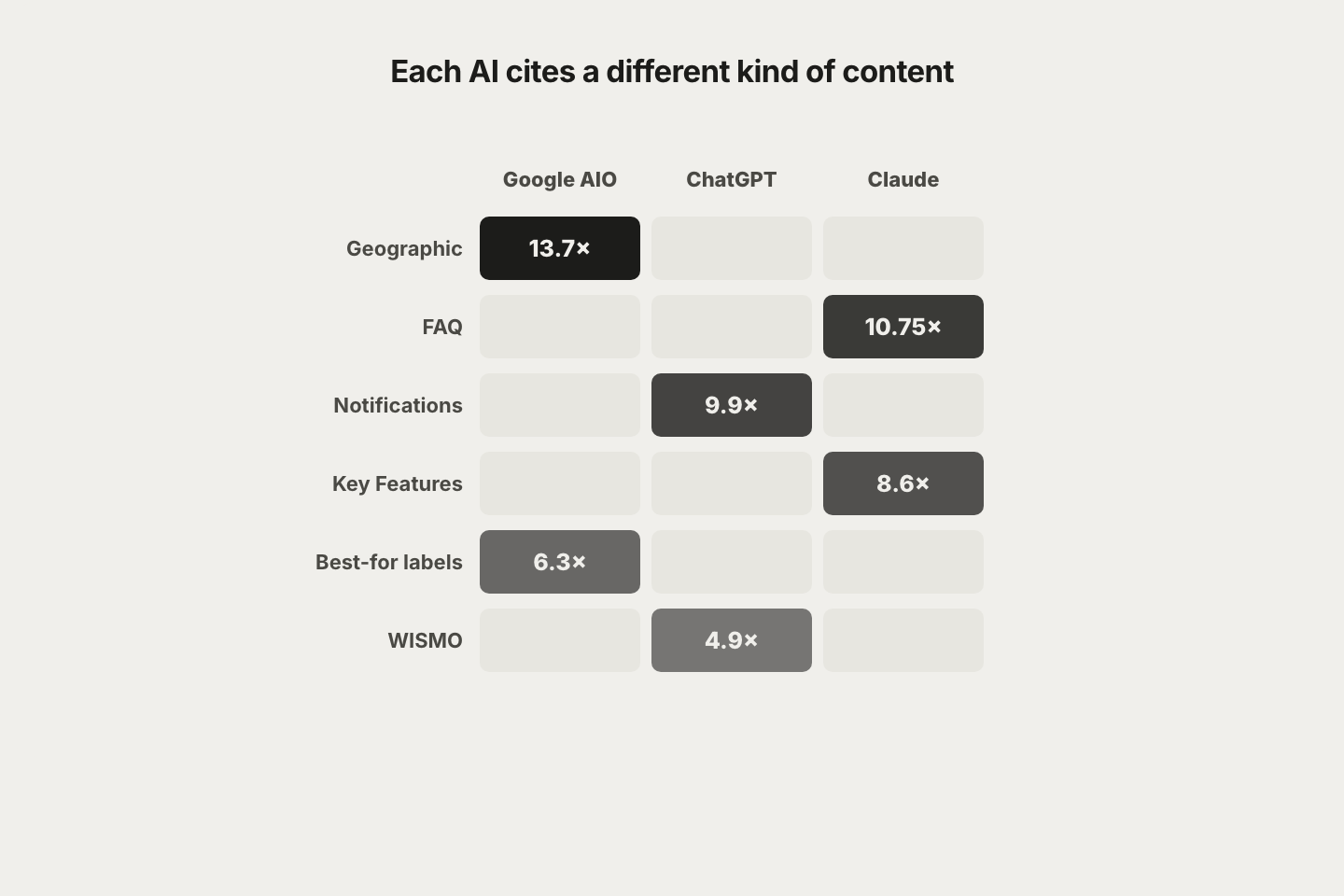 How much more each AI cites a given content signal. Darker cell = stronger pull. Different engines reward different content — there's no single format that wins everywhere.
5. Then optimize the tone — without tipping into spin. Once you're cited, whether the mention is warm depends on what your cited page says. But you can't just rewrite everything to flatter yourself: models are wary of non-neutral, self-promotional pages and will quietly stop citing them. The move that works is owning the honest version of the story. A few examples:
- Rank for the criticism of your own brand. If buyers search "[Brand] is too expensive," be the page that addresses it head-on — name the concern, then give the context (who it's the wrong fit for, where the value actually shows up). A fair page that ranks for the objection lets the AI cite your framing of it instead of a competitor's.
- Write persona-specific rebuttals. The same knock lands differently by buyer. "Too expensive" for an SMB → show the entry tier and time-to-value; for enterprise → show the per-seat math against the cost of the problem it removes. Give the model a neutral, citable source for each version.
- Concede real trade-offs. Pages that admit where a rival is genuinely a better fit read as trustworthy and keep getting cited; pages that claim to win on everything get dropped.
Rule of thumb: be the most useful neutral source on your own weak points, not the loudest advocate. That's what stays cited.
The takeaway
A mention is the door. A citation is the story — and the story is only defensible if your own pages are in the sources the model reads. Get indexed, earn the citation, then shape the tone. In that order.
People Also Ask
More on AI Citation Gap Analyzer
Why AI Recommends Your Brand but Won't Cite It (2026)
AI assistants recommend your brand from memory but cite competitors from live search. Here's the "mentioned but not cited" gap — and the three fixes: ranking, structure, and crawl access.
AI Search Optimization: Get Traffic from ChatGPT Guide
Q: How is Google AI affecting SEO? A: Google AI is transforming SEO through AI Overviews and generative search results that directly answer user queries. This reduces traditional click-through…