
AI Search Optimization: Get Traffic from ChatGPT Guide
Section 1: How LLM Search and Orchestrate
The Discovery That Changed AI Search Understanding
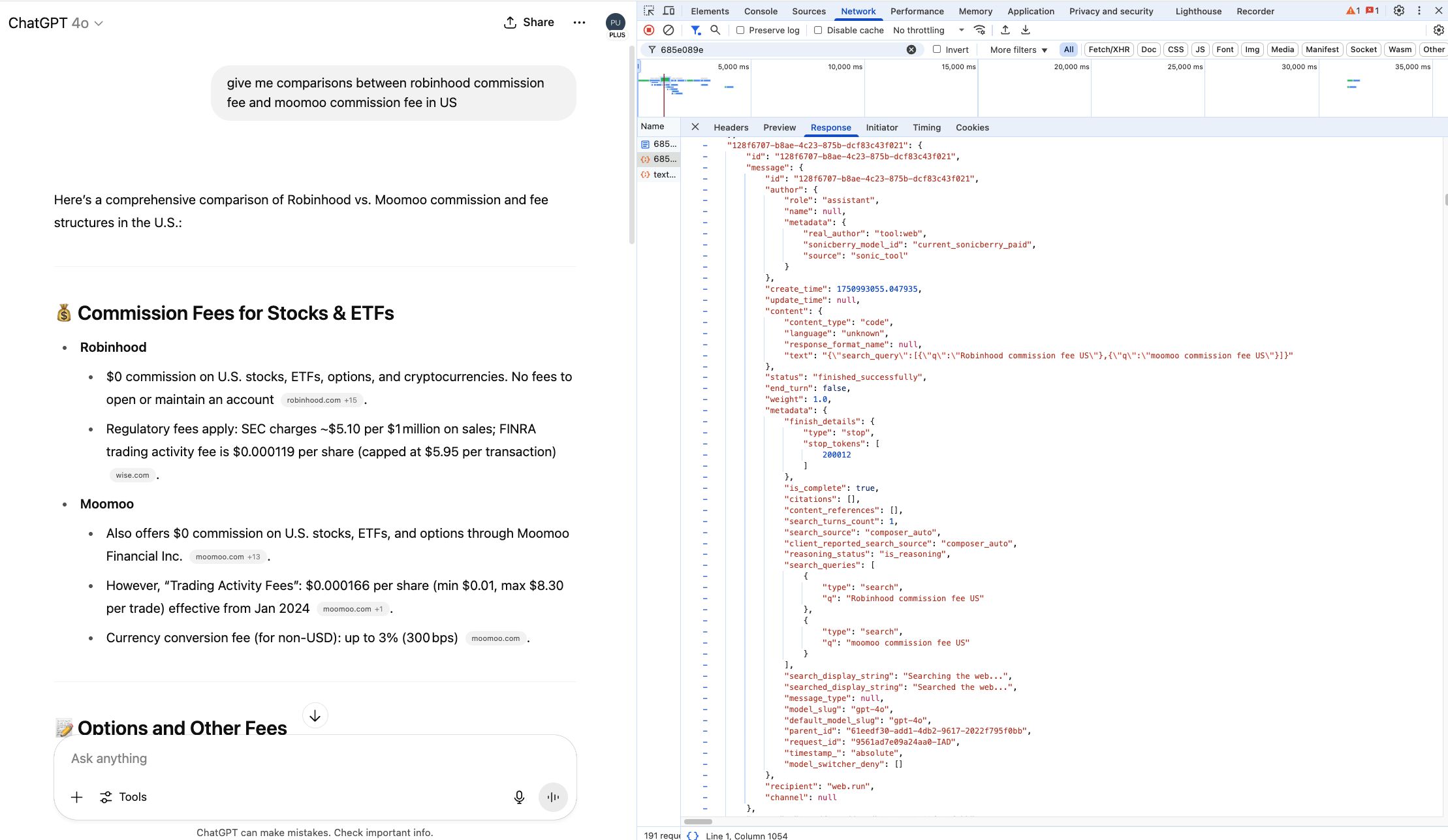
A groundbreaking discovery by Jérôme Salomon revealed something fascinating about how ChatGPT operates behind the scenes. When ChatGPT needs to search for information, it actually produces a JSON file that exposes the exact search queries it performs. This revelation, shared by Chris Go Fish on social media, opened up an unprecedented window into the AI search optimization process that powers modern language models.
💡 Key Insight: For the first time, we can actually see how AI search engines think and plan their information gathering strategies. This discovery is revolutionary for anyone working in SEO for AI search engines because it demonstrates that these systems don't just randomly search—they follow sophisticated, structured approaches that we can understand and optimize for.
Real-World Case Study: ChatGPT VS Perplexity, How Do They Search Differently
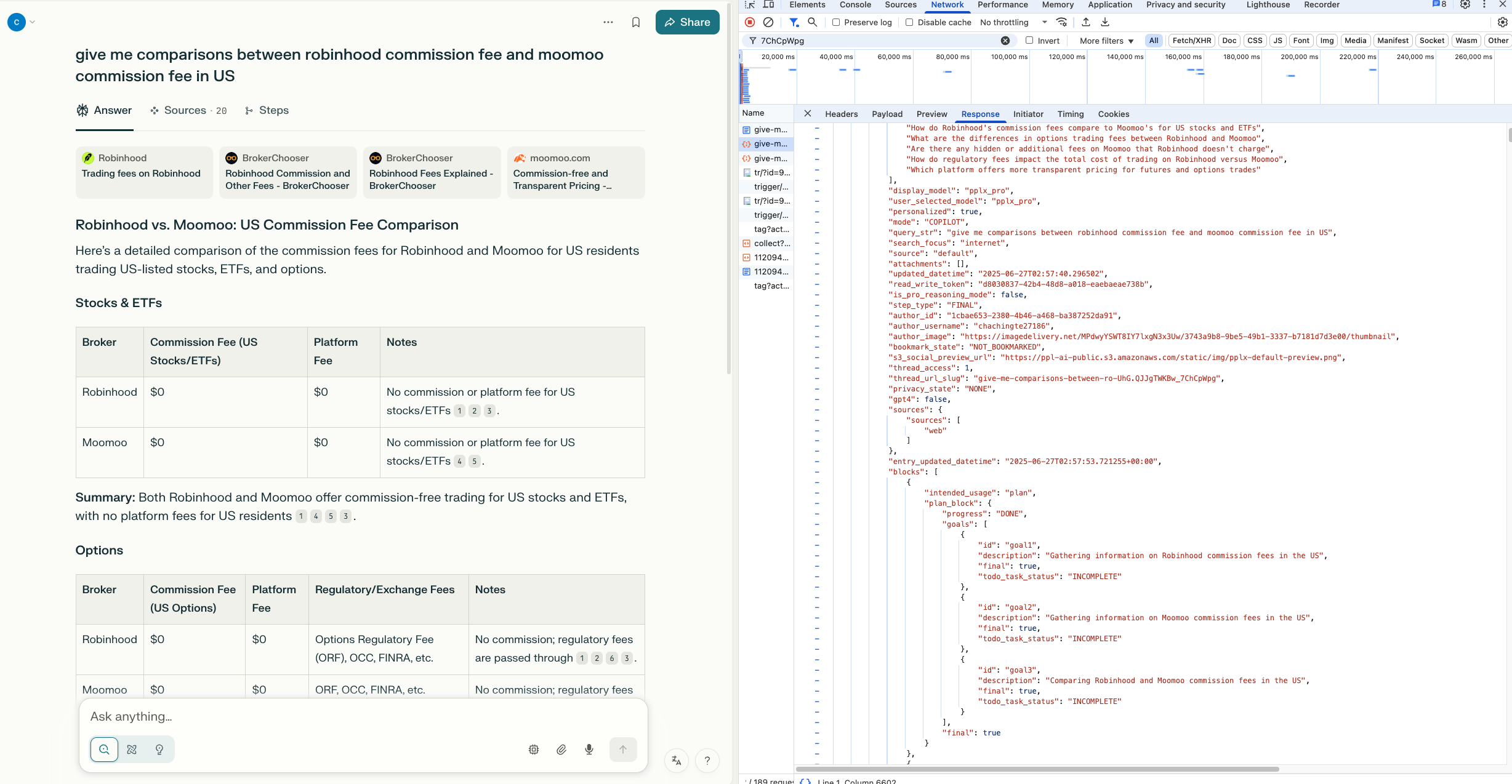
To understand how different AI search engines approach the same query, I conducted a practical experiment using both Perplexity and ChatGPT. The test query was straightforward: "Give me comparisons between Robinhood commission fee and Moomoo commission fee in US." The results revealed dramatically different search orchestration strategies, providing crucial insights for anyone looking to get SEO traffic from ChatGPT and get SEO traffic from Perplexity.
The Experiment Setup
Query: "Give me comparisons between Robinhood commission fee and Moomoo commission fee in US" Test Subjects:
- Perplexity AI (using COPILOT mode)
- ChatGPT (with web search enabled)
Observation Method: JSON file analysis and search pattern documentation
How Two LLMs Search and Orchestrate: A Deep Comparison
The following analysis reveals the fundamental differences in how these AI search engines operate, providing essential insights for chatgpt seo and perplexity seo strategies.
Strategic Approach Differences
Perplexity: Goal-Based Planning Architecture
"goals": [
  {"id": "goal1", "description": "Gathering information on Robinhood commission fees"},
  {"id": "goal2", "description": "Gathering information on Moomoo commission fees"},
  {"id": "goal3", "description": "Comparing Robinhood and Moomoo commission fees"}
]
Perplexity employs a divide and conquer methodology that breaks complex queries into strategic sub-goals. Each goal receives its own dedicated research phase, following a predetermined research methodology with sequential execution.
ChatGPT: Parallel Search with Reasoning
"search_query": [
  {"q": "Robinhood commission fee US"},
  {"q": "moomoo commission fee US"}
]
ChatGPT takes a different approach with parallel processing, executing simultaneous multi-query searches. It begins with a 2-second internal reasoning phase before search execution, then adapts its strategy dynamically based on initial findings.
Search Query Generation Patterns
| Aspect | Perplexity | ChatGPT |
|---|---|---|
| Query Depth | 3+ queries per goal (9+ total) | 2 parallel queries |
| Temporal Awareness | Explicit year queries ("2025") | Implicit recency preference |
| Query Variations | Direct, temporal, structural | Direct, entity-focused |
| Search Limit | 8 results per query | Variable results |
Perplexity's Multi-Query Strategy:
Goal 1: "Robinhood commission fees US"
        "Robinhood trading fees 2025"
        "Robinhood commission structure US"
ChatGPT's Focused Strategy:
"Robinhood commission fee US"
"moomoo commission fee US"
Web Search API & Technical Infrastructure
Perplexity
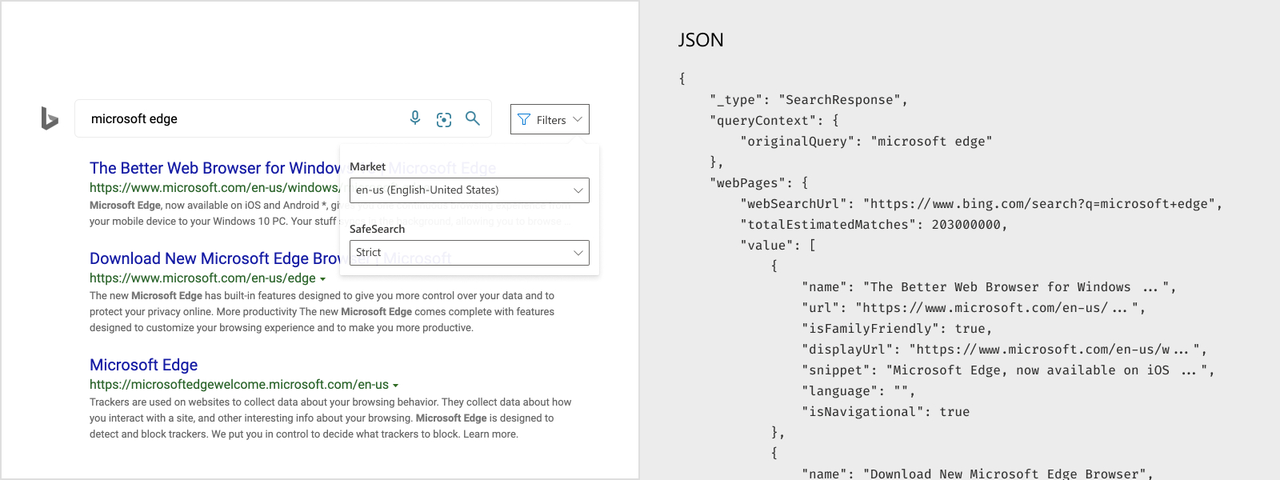
- Provider Specific: Appears to use Bing Search API (based on JSON response structure)
- Structured Limits: Fixed 8 results per query
- Result Classification: Complex categorization system
- Planning Mode: "COPILOT" advanced mode
💡 Technical Evidence: The JSON response payload structure reveals Bing Search API usage:
{
  "name": "Trading fees on Robinhood",
  "url": "https://robinhood.com/support/articles/trading-fees-on-robinhood/",
  "snippet": "As of January 1, 2024, the TAF is $0.000166 per share (equity sells) and $0.00279 per contract (options sells). This fee is rounded to the nearest penny, which ...",
  "is_attachment": false,
  "is_memory": false,
  "is_conversation_history": false,
  "is_navigational": false,
  "is_focused_web": false
}
This response format matches the standard Bing Search API payload structure.
ChatGPT
- Provider Specific: Appears to use Brave Search API
- Dynamic Results: Variable result counts
- Domain Grouping: Results organized by website domain
- Sonic Classification: Probability-based search triggers
Source Quality Control Mechanisms
Perplexity: Aggressive Filtering
"status": "SELECTED"  // Only 7/20 sources selected
"citation": 1
Perplexity implements a three-tier system: SELECTED → REVIEWED → REJECTED. With a quality-first approach, it uses aggressive filtering with only a 35% selection rate, suggesting more manual curation in the selection process.
ChatGPT: Comprehensive Attribution
"attribution_segments": ["0-1", "321-0", "658-0"]
"supporting_websites": [/* multiple sources per claim */]
ChatGPT employs multi-source verification where every claim is backed by multiple sources. It uses granular attribution with sentence-level source mapping and maintains fallback systems with alternative sources for verification.
Attribution segments work by mapping specific portions of the response to their source documents. For example, "321-0" means characters 321 onwards in the response are sourced from document 0 in the search results. This granular tracking allows ChatGPT to provide precise source attribution for each sentence or claim, ensuring transparency about where each piece of information originated.
Response Synthesis & Presentation
Despite their different search methodologies, both systems converge on remarkably similar presentation patterns:
Shared Formatting Approaches
- ✅ Comparative tables
- ✅ Clear section headers
- ✅ Executive summary/takeaways
- ✅ Actionable conclusions
Common Information Hierarchy
- ✅ Commission fees first (core query)
- ✅ Additional fees breakdown
- ✅ Platform-specific features
- ✅ Recommendation section
Citation Methodologies
- ✅ Numbered citations
- ✅ Source attribution
- ✅ Multiple source verification
Key Presentation Differences
| Feature | Perplexity | ChatGPT |
|---|---|---|
| Streaming | Chunk-based streaming | Complete response |
| Citations | Numbered references | Inline attributions |
| Visual Elements | Goal-based organization | Emoji-enhanced sections |
| Length | More concise | More comprehensive |
What Both Systems Prioritize (SEO Gold Mine):
Content Type Preferences:
- Official Documentation (Highest Priority)
- Company support pages
- PDF fee schedules
- Pricing pages
- Authority Financial Sites (High Priority)
- Investopedia, BrokerChooser
- Established financial media
- Recent Content (Critical Factor)
- 2025 dates prioritized
- "Updated" or "revised" content
Structural Elements That Get Cited:
- ✅ Comparison tables
- ✅ FAQ sections
- ✅ Step-by-step breakdowns
- ✅ Current fee schedules
- ✅ Clear policy statements
Key Strategic Differences Summary
Perplexity's Strengths
- Methodical Planning: Goal-oriented research approach
- Comprehensive Coverage: Multiple query variations per topic
- Quality Filtering: Aggressive source selection
- Structured Output: Consistent response templates
ChatGPT's Strengths
- Reasoning Integration: Transparent thinking process
- Attribution Depth: Granular source tracking
- Parallel Processing: Efficient simultaneous searches
- Comprehensive Analysis: Detailed cross-referencing
Section 2: Search API Providers Matter - Understanding the Foundation of AI Search
Major LLM Search Systems and Their API Providers
Understanding which search API each AI search engine uses is crucial for developing effective SEO for AI search engines strategies. Each major language model has made strategic partnerships or built proprietary systems that directly impact how content gets discovered and ranked.
ChatGPT (OpenAI)
Search Provider: Brave Search API
- Implementation: Real-time web search integration
- Search Behavior: Parallel query processing with dynamic result counts
- Index Characteristics: Independent web crawling with privacy-focused approach
- Attribution Method: Granular sentence-level source mapping
Perplexity AI
Search Provider: Bing Search API (Microsoft)
- Implementation: Goal-based planning architecture with structured queries
- Search Behavior: Sequential execution with 8 results per query limit
- Index Characteristics: Leverages Microsoft's web index and ranking algorithms
- Attribution Method: Numbered citation system with aggressive filtering
Grok (xAI)
Search Provider: Real-time X (Twitter) integration + Web search
- Implementation: Hybrid approach combining social media and traditional web search
- Search Behavior: Social signal prioritization with real-time data access
- Index Characteristics: Unique access to X platform data plus standard web crawling
- Attribution Method: Social media context integration
Claude (Anthropic)
Search Provider: Brave Search API
- Implementation: Constitutional AI-guided search with safety filtering
- Search Behavior: Balanced approach between comprehensiveness and reliability
- Index Characteristics: Privacy-focused indexing with content quality emphasis
- Attribution Method: Multi-source verification with ethical considerations
Why Search API Providers Matter for SEO Strategy
Understanding which search engine powers each AI system is fundamental to AI Search Optimization because each provider has developed distinct web indexing methodologies and ranking signals. This means that optimizing for chatgpt seo requires different strategies than optimizing for perplexity seo.
Different Web Indexes, Different Opportunities
Each search API provider maintains its own web crawling infrastructure and ranking algorithms: Brave Search (used by ChatGPT and Claude):
- Independent web index built from scratch
- Privacy-focused crawling policies
- Ad-free result prioritization
- Community-driven spam detection Bing Search (used by Perplexity):
- Microsoft's comprehensive web index
- Integration with Microsoft ecosystem signals
- LinkedIn and Office 365 data integration
- Enterprise and business content prioritization X Platform Integration (Grok's unique advantage):
- Real-time social media signals
- Trending topic prioritization
- Social engagement metrics
- Viral content detection algorithms
Key Ranking Signal Differences Between Google and Bing
Since many AI systems rely on Bing's infrastructure, understanding how Bing differs from Google is crucial for anyone looking to get SEO traffic from ChatGPT and get SEO traffic from Perplexity:
Content Freshness Signals
- Google: Emphasizes E-A-T (Experience, Expertise, Authoritativeness, Trustworthiness) with gradual content updates
- Bing: Prioritizes recent publication dates and "updated" timestamps more aggressively
Social Media Integration
- Google: Limited direct social signal integration
- Bing: Strong integration with Facebook, Twitter, and LinkedIn engagement metrics
Domain Authority Factors
- Google: Complex domain authority calculations with historical performance
- Bing: More emphasis on exact match domains and keyword-rich URLs
Content Length Preferences
- Google: Favors comprehensive, long-form content (2000+ words)
- Bing: Better performance with concise, direct answers (800-1500 words)
Multimedia Content Handling
- Google: Advanced image and video understanding with AI-powered analysis
- Bing: Strong preference for pages with relevant images and proper alt-text
Local SEO Signals
- Google: Sophisticated local business understanding through Google My Business
- Bing: Heavier reliance on directory listings and citation consistency
Technical SEO Requirements
- Google: Advanced Core Web Vitals and user experience metrics
- Bing: More forgiving of technical issues but rewards clean, semantic HTML
Section 3: How to Get SEO Traffic from LLM (ChatGPT & Perplexity)
The Evolution Beyond Traditional SEO
From our analysis in previous sections, we've discovered fundamental differences in how AI search engines like ChatGPT and Perplexity process queries and retrieve information. ChatGPT employs parallel processing with Brave Search API, while Perplexity uses goal-based planning with Bing Search API. Despite these technical differences, one crucial insight emerges: traditional SEO still matters. Regardless of which search API ChatGPT uses, all search engines generally follow similar SEO ranking fundamentals - authority, relevance, freshness, and user experience signals remain core ranking factors. However, the future belongs to those who master both SEO + GEO (Generative Engine Optimization). This hybrid approach will thrive the most in capturing traffic from AI-powered search platforms. The convergence of traditional search principles with AI-specific optimization creates unprecedented opportunities for content creators and SEO professionals looking to get SEO traffic from ChatGPT and get SEO traffic from Perplexity.
How GEO + SEO Works Together to Capture AI Traffic
AI Search Query Intelligence: Beyond Traditional Keyword Research
Instead of solely relying on Google Trends, SEMrush, and Ahrefs, website owners should prioritize AI search query extraction as their primary research methodology. As we discovered in Section 1, Perplexity and ChatGPT parse queries in distinctly different ways - Perplexity breaks complex queries into strategic sub-goals, while ChatGPT processes parallel searches with dynamic reasoning. Understanding these query parsing patterns is crucial for AI Search Optimization. When a user asks "compare Robinhood vs Moomoo fees," Perplexity might generate three separate research goals, while ChatGPT executes two parallel searches. This means your content needs to satisfy both methodologies.
💡 Recommended Tool: Use the ChatGPT Search Query Extractor to understand exactly how ChatGPT processes your target topics into search queries. This tool reveals the actual JSON queries ChatGPT generates, providing invaluable insights for optimizing your chatgpt seo strategy. By understanding these query patterns, you can structure content that aligns with how AI systems naturally search for information.
Traditional SEO Fundamentals Still Drive AI Discovery
While AI search introduces new optimization opportunities, traditional SEO techniques remain the foundation of discoverability: Traditional SEO elements like backlinks, internal linking, and comprehensive content coverage remain important as they signal authority and topical depth to the underlying search APIs. Multi-Engine Indexation Strategy: Given our Section 2 analysis of different search API providers, submit your content for indexation across major search engines:
- Google: For general web discovery and potential future AI integration
- Bing: Direct pipeline to Perplexity and other Microsoft-powered AI tools
- Brave Search: Direct access to ChatGPT and Claude search results This multi-engine approach ensures your content appears in the underlying indexes that power AI search platforms.
AI-Friendly Content Structure: The Technical Foundation
AI systems excel at parsing structured, semantic content. Implementing proper HTML5 elements, schema markup, and data attributes creates machine-readable content that AI can easily process and cite.
Semantic HTML5 Elements
Use proper heading hierarchy and semantic elements to create clear content structure:
<article>
  <header>
    <h1>Commission Fee Comparison: Robinhood vs Moomoo</h1>
    <time datetime="2025-01-15">Updated January 15, 2025</time>
  </header>
  <section>
    <h2>Stock Trading Fees</h2>
    <table>
      <thead>
        <tr>
          <th>Platform</th>
          <th>Stock Trades</th>
          <th>ETF Trades</th>
        </tr>
      </thead>
      <tbody>
        <tr>
          <td>Robinhood</td>
          <td>$0.00</td>
          <td>$0.00</td>
        </tr>
      </tbody>
    </table>
  </section>
  <aside>
    <h3>Key Takeaway</h3>
    <p>Both platforms offer commission-free stock trading.</p>
  </aside>
</article>
Schema.org Markup
Implement structured data to help AI systems understand content context:
<div itemscope itemtype="https://schema.org/Comparison">
  <h2 itemprop="name">Trading Platform Comparison</h2>
  <div itemprop="compareItem" itemscope itemtype="https://schema.org/Product">
    <span itemprop="name">Robinhood</span>
    <span itemprop="offers" itemscope itemtype="https://schema.org/Offer">
      <span itemprop="price">0</span>
      <span itemprop="priceCurrency">USD</span>
    </span>
  </div>
</div>
Data Attributes for Categorization
Use custom data attributes to provide additional context:
<section data-content-type="comparison" data-topic="trading-fees" data-last-updated="2025-01-15">
  <h2>Commission Structure Analysis</h2>
  <div data-platform="robinhood" data-fee-type="stock-trading">
    <p>Robinhood charges $0 commission for stock trades.</p>
  </div>
</section>
Clean DOM Tree and ARIA Labels: The AI Navigation Imperative
Clean DOM structure and proper ARIA labeling have become critical for AI traffic, as demonstrated by recent developments in AI web navigation. Opera's AI integration exemplifies why this matters: Opera uses DOM tree technology and browser layout data to understand webpage content, rather than analyzing visual pixels or screenshots. This approach means Opera's AI doesn't need to "see" your webpage visually or navigate with mouse pointers. Instead, it directly interacts with the web structure, enabling sophisticated task automation like:
- E-commerce Navigation: AI can purchase products and add items to cart
- Financial Analysis: AI can navigate to find latest stock prices and perform analysis
- Form Completion: AI can fill out complex forms and submit data
- Content Extraction: AI can locate and extract specific information efficiently If you want your website to be navigable by AI for these advanced use cases, you must provide a clean DOM tree and understandable labels:
<section class="authentication-section" role="region" aria-label="User Authentication">
    <button class="primary-cta-button clickable-element"
            type="button"
            data-action="open-auth-modal"
            data-testid="auth-button"
            data-next-step="modal"
            data-next-content="signup-login-form"
            data-destination-url="/auth/modal"
            data-flow-description="Opens authentication modal with signup and login options"
            data-expected-elements="email-field,password-field,submit-button"
            data-user-journey="authentication → dashboard"
            aria-label="Sign up for new account or login to existing account"
            aria-describedby="auth-description auth-flow">
        <span class="button-text">Get Started</span>
        <span class="sr-only">Opens authentication options</span>
    </button>
    <!-- Rich context for AI understanding -->
    <div class="ai-navigation-context" aria-hidden="true" style="display: none;">
        <div id="auth-description">
            Click to access sign up and login options for your account
        </div>
        <div id="auth-flow" data-ai-context="navigation-flow">
            <span data-step="1">Opens authentication modal</span>
            <span data-step="2">User enters email and password</span>
            <span data-step="3">Redirects to dashboard after successful authentication</span>
        </div>
        <div data-ai-context="expected-outcomes">
            <span data-success-redirect="/dashboard">User dashboard with account overview</span>
            <span data-alternative-action="/forgot-password">Password reset option available</span>
            <span data-signup-redirect="/onboarding">New user onboarding flow</span>
        </div>
        <div data-ai-context="required-inputs">
            <span data-field="email" data-type="email" data-required="true">Valid email address</span>
            <span data-field="password" data-type="password" data-required="true">Password (min 8 characters)</span>
        </div>
    </div>
</section>
This structured approach enables AI systems to understand not just your content, but how users can interact with your website programmatically. With the enhanced markup shown above, AI can perform sophisticated analysis: AI Analysis with Enhanced Markup:
- ✅ "This button opens an authentication modal"
- ✅ "The modal will have email and password fields"
- ✅ "Successful auth leads to /dashboard"
- ✅ "New users go to /onboarding"
- ✅ "Dashboard contains account overview and navigation"
- ✅ "I can plan the complete user journey"
The
data-ai-contextattributes provide explicit guidance about navigation flows, expected outcomes, and required inputs, allowing AI to understand complex user interactions without visual interpretation.
Featured Snippet Optimization: Direct Answers and TLDR Strategy
AI search platforms prioritize content that provides direct, concise answers to user queries. Featured snippet optimization for perplexity seo requires creating content that satisfies both human readers and AI parsing algorithms.
When designing FAQ sections, Perplexity's response payload provides valuable insights through its related_query_items. These related queries serve as an excellent reference for enriching your own FAQ content:
"related_query_items": [
  {
    "text": "How do Robinhood's commission fees compare to Moomoo's for US stocks and ETFs",
    "type": "DEFAULT"
  },
  {
    "text": "What are the differences in options trading fees between Robinhood and Moomoo",
    "type": "DEFAULT"
  },
  {
    "text": "Are there any hidden or additional fees on Moomoo that Robinhood doesn't charge",
    "type": "DEFAULT"
  },
  {
    "text": "How do regulatory fees impact the total cost of trading on Robinhood versus Moomoo",
    "type": "DEFAULT"
  },
  {
    "text": "Which platform offers more transparent pricing for futures and options trades",
    "type": "DEFAULT"
  }
]
These related queries reveal the natural follow-up questions users have, providing a roadmap for comprehensive FAQ development. Structure your answers to directly address these variations:
<section itemscope itemtype="https://schema.org/FAQPage">
  <h2>Frequently Asked Questions</h2>
  <div itemscope itemprop="mainEntity" itemtype="https://schema.org/Question">
    <h3 itemprop="name">How do Robinhood's commission fees compare to Moomoo's for US stocks and ETFs?</h3>
    <div itemscope itemprop="acceptedAnswer" itemtype="https://schema.org/Answer">
      <div itemprop="text">
        <p><strong>TLDR:</strong> Both Robinhood and Moomoo offer $0 commission for US stock and ETF trades.</p>
        <p>Detailed comparison: [comprehensive answer follows]</p>
      </div>
    </div>
  </div>
</section>
Key Optimization Strategies:
- Lead with TLDR: Provide immediate answers for AI extraction
- Use Related Queries: Mine Perplexity's related queries for FAQ expansion
- Structure for Scanning: Use clear headings and bullet points
- Include Comparison Tables: AI systems prioritize tabular data for citations
- Timestamp Updates: Clearly mark when information was last verified This comprehensive approach to SEO for AI search engines ensures your content satisfies both traditional search algorithms and emerging AI platforms, maximizing your visibility across the evolving search landscape.
Section 4: Final Thoughts - The AI Web Revolution
Don't Swim Against the Current: Embracing the GEO + SEO Era
The digital landscape is experiencing a fundamental shift, and those who fail to adapt risk being swept away by forces beyond their control. It's GEO + SEO time - the era of traditional SEO-only strategies is ending. Smart businesses recognize this transformation and follow the market's lead rather than clinging to outdated methodologies. History is littered with companies that swam against technological currents, only to find themselves obsolete: The DSP vs. Giants Battle: Countless Demand Side Platforms emerged, promising to revolutionize digital advertising. Yet they struggled against the gravitational pull of Facebook Ads FAN and Google Ad Network. These platforms had already built the infrastructure, relationships, and scale that made them nearly impossible to displace. The Mobile Revolution Casualties: Consider CyberLink, once a powerhouse in desktop multimedia software. Their early products dominated the PC market, but when the mobile wave arrived, they hesitated. While competitors pivoted aggressively to mobile apps, CyberLink remained anchored to desktop solutions. By the time they recognized the shift, competitors had already captured mobile market share, and CyberLink found themselves perpetually playing catch-up. The lesson is clear: technological transitions create winners and losers based on timing and adaptability, not just product quality.
The Web's Renaissance: More Important Than Ever
AI Agent Accessibility - The New Digital Divide
A surprising reversal is occurring in the tech world. While many predicted native apps would dominate digital experiences, the web is becoming the "AI-accessible layer" of digital experiences - and semantic HTML is the language that makes this possible. Native iOS/Android Apps:
- ❌ Closed ecosystems that resist external access
- ❌ App Store gatekeepers controlling distribution and discovery
- ❌ Platform-specific APIs creating fragmentation
- ❌ Architectural barriers preventing AI agent interaction Web Applications:
- ✅ Open, standards-based foundation enabling universal access
- ✅ Cross-platform by design, working across any device or system
- ✅ AI agents can interact directly via DOM manipulation
- ✅ No platform restrictions or permission requirements This accessibility advantage means that businesses investing in AI-optimized web experiences are building for the future, while those doubling down on app-only strategies may find themselves isolated from AI-driven traffic.
The Coming Industrial Agreement: Standards for AI-Web Interaction
The current AI-web interaction landscape resembles the early days of the internet - fragmented, proprietary, and lacking unified standards. Just as the MCP (Model Context Protocol) emerged for AI server communication, we desperately need standardized protocols for AI-web interaction.
Individual Efforts Creating Fragmentation:
Opera → Uses DOM tree analysis (proprietary approach)
OpenAI → Screenshot + vision models (resource-intensive method)
Microsoft → Copilot Vision + OCR (hybrid approach)
Anthropic → Web tools + HTML parsing (structured approach)
Each company is developing isolated solutions, creating a Tower of Babel scenario where AI agents struggle to interact consistently across different platforms and websites.
Required Participants for Standardization:
- Google (Chrome - 65% market share)
- Apple (Safari - iOS ecosystem control)
- Microsoft (Edge + enterprise integration)
- Mozilla (Firefox - open web advocacy)
- Opera (innovation leadership) Potential AI Web Standards Leaders:
- OpenAI (if ChatGPT browsing becomes the dominant AI interaction model)
- Google (if they successfully integrate AI agents into Chrome browser)
- Microsoft (if Copilot becomes the universal AI assistant) The company that successfully leads this standardization effort will shape how billions of AI interactions occur, creating immense strategic value.
Platform Conflicts: The Invisible Obstacles Ahead
The path to AI-web standardization faces significant headwinds from existing platform economics. Each major player has compelling reasons to resist making AI interaction too seamless: Apple's Dilemma: "Why make it easier for AI agents to bypass our App Store?" Apple's $85 billion App Store revenue depends on users staying within their controlled ecosystem. AI agents that can accomplish tasks through web interfaces threaten to reduce native app downloads, directly impacting Apple's most profitable business segment. Google's Contradiction: "Why help competitors' AI agents work better on our platform?" Google faces a paradox: as the web's biggest advocate, they should support AI-web standards, yet as an AI competitor, they have incentives to make their own AI tools work better than others. Their ad-supported model also depends on user engagement, not automated task completion. Meta's Walled Garden Strategy: "Why make it easier for users to leave our platforms?" Meta's entire business model relies on capturing and retaining user attention within Facebook, Instagram, and WhatsApp. AI agents that can efficiently extract information or complete tasks without prolonged engagement threaten their advertising revenue model. These conflicts create a tragedy of the commons scenario where individual platform interests work against collective progress toward AI-web standardization.
The Keyword Strategy Evolution: Trust, Capability, and Intent
The future of SEO for AI search engines will be determined by three critical factors that separate winning content from obsolete approaches:
Trust Threshold: The AI Confidence Divide
Payment and Financial Transactions represent the ultimate trust test. Users readily ask AI to research products, compare prices, and even find deals, but hesitate when actual payment processing is involved. This creates a clear content opportunity divide:
- High-Trust Content: Product comparisons, feature analysis, pricing research
- Medium-Trust Content: Booking assistance, form filling, account setup guidance
- Low-Trust Content: Direct payment processing, sensitive data handling Understanding this trust spectrum helps prioritize which content to optimize for AI discovery versus traditional search.
Capability Boundaries: What AI Can Complete Independently
Stock Trading and Flight Booking exemplify tasks where AI capability determines content strategy. When AI agents can independently execute complete workflows - from research to booking confirmation - the content that gets cited becomes incredibly valuable. We put numbers on that value — cited answers scored about 20% higher brand sentiment and were dropped from the answer 3.6× less often. High-Capability Scenarios:
- Research → Compare → Recommend → Execute
- Content must provide clear, actionable steps for AI completion Limited-Capability Scenarios:
- Research → Compare → Recommend → Hand-off to human
- Content focuses on decision-making support rather than execution
SEO's Enduring Foundation: The RAG Reality
Despite AI's sophistication, GEO primarily captures high-intent traffic because AI search fundamentally operates as an advanced RAG (Retrieval-Augmented Generation) process combined with intelligent prompting and custom search capabilities. This technical reality means SEO fundamentals remain crucial: Internal Link Architecture still determines how AI systems discover and understand content relationships within your site. When ChatGPT or Perplexity crawls your domain, strong internal linking guides them to your most authoritative content. Backlink Authority continues to signal trustworthiness to underlying search APIs, whether Brave Search, Bing, or future AI-specific indexes. Strategic Adaptation Required:
- Reassess High-Intent Keywords: Identify which keywords represent strong user intent that AI systems are likely to process and act upon
- Realign Internal Link Strategy: Restructure your site's internal linking to support AI content discovery patterns, not just traditional user navigation
- Evolve Backlink Strategy: Focus on earning links from sources that AI systems recognize as authoritative, including technical documentation, research publications, and established industry resources The businesses that recognize this evolution - where traditional SEO provides the foundation while GEO captures the high-value, high-intent traffic - will thrive in the AI-driven search landscape. Those that abandon SEO fundamentals in favor of AI-only optimization will find themselves building on unstable ground. The future belongs to those who master both traditional authority signals and AI-specific optimization techniques, creating content that satisfies both human users and AI systems in this new era of AI Search Optimization. Lean more of why AI recommends you but wouldn't cite you
People Also Ask
More on AI Citation Gap Analyzer
Do You Know You Can Get AI to Recommend You More?
AI already mentions your brand — but a mention isn't a recommendation. You can influence whether AI recommends you, and it starts with getting cited. Here's how. (≈157 chars — trim to ≤155 on your final pick.)
Why AI Recommends Your Brand but Won't Cite It (2026)
AI assistants recommend your brand from memory but cite competitors from live search. Here's the "mentioned but not cited" gap — and the three fixes: ranking, structure, and crawl access.