
Text Sentiment Analysis with Python: A Comprehensive Guide
In today's data-driven world, understanding public opinion has become crucial for businesses, researchers, and organizations. Text sentiment analysis with Python offers powerful capabilities to decode emotions, opinions, and attitudes hidden within vast amounts of textual data. Whether you're analyzing customer feedback, social media posts, or research surveys, Python's robust ecosystem provides the tools needed for effective text sentiment analysis with python nltk text classification.
This comprehensive guide will walk you through everything from basic concepts to advanced implementation techniques, ensuring you have the knowledge to tackle real-world sentiment analysis challenges.
Applications and Use Cases of Sentiment Analysis
Understanding where and how sentiment analysis applies in real-world scenarios is essential for maximizing its potential impact.
Business Intelligence and Market Research
Customer reviews represent one of the most valuable data sources for businesses today. Companies leverage sentiment analysis to automatically process thousands of reviews, identifying patterns that would be impossible to detect manually.
💡 Real-World Example: E-commerce platforms like Amazon process millions of product reviews daily, using sentiment analysis to highlight positive feedback and flag potential issues before they escalate.
Social media sentiment monitoring has revolutionized how brands track their reputation. Organizations can now:
- Monitor brand perception in real-time across multiple platforms
- Identify emerging market trends before competitors
- Respond proactively to negative sentiment spikes
Financial Market Prediction and Investment Strategy
Fed rate prediction represents one of the most sophisticated applications of sentiment analysis in finance. Bloomberg has developed a natural language processing model called "Fedspeak" that analyzes Federal Reserve communications to predict interest rate movements. This model, trained on over 6,200 speaking engagements by Fed officials since 2009, demonstrates how sentiment analysis can provide actionable investment insights.
The model works by assigning sentiment scores to Fed communications, where readings below zero imply potential rate cuts, while scores above zero indicate a tightening bias. According to Apollo Academy's analysis, this Bloomberg NLP model has consistently shown Fed sentiment favoring rate hikes rather than cuts, providing investors with data-driven insights for bond and equity positioning strategies ahead of FOMC meetings.
💡 Learn More: To explore additional applications beyond financial markets, check out comprehensive sentiment analysis use cases across various industries.
Academic and Research Applications
Academic researchers utilize customer sentiment analysis to study consumer behavior, social movements, and cultural shifts. This application proves particularly valuable in:
- Political science research analyzing public opinion
- Marketing research understanding consumer preferences
- Sociology studies examining social media's impact on society
Supporting Technologies and Tools for Sentiment Analysis
Python's ecosystem offers numerous powerful libraries and frameworks for implementing sentiment analysis solutions.
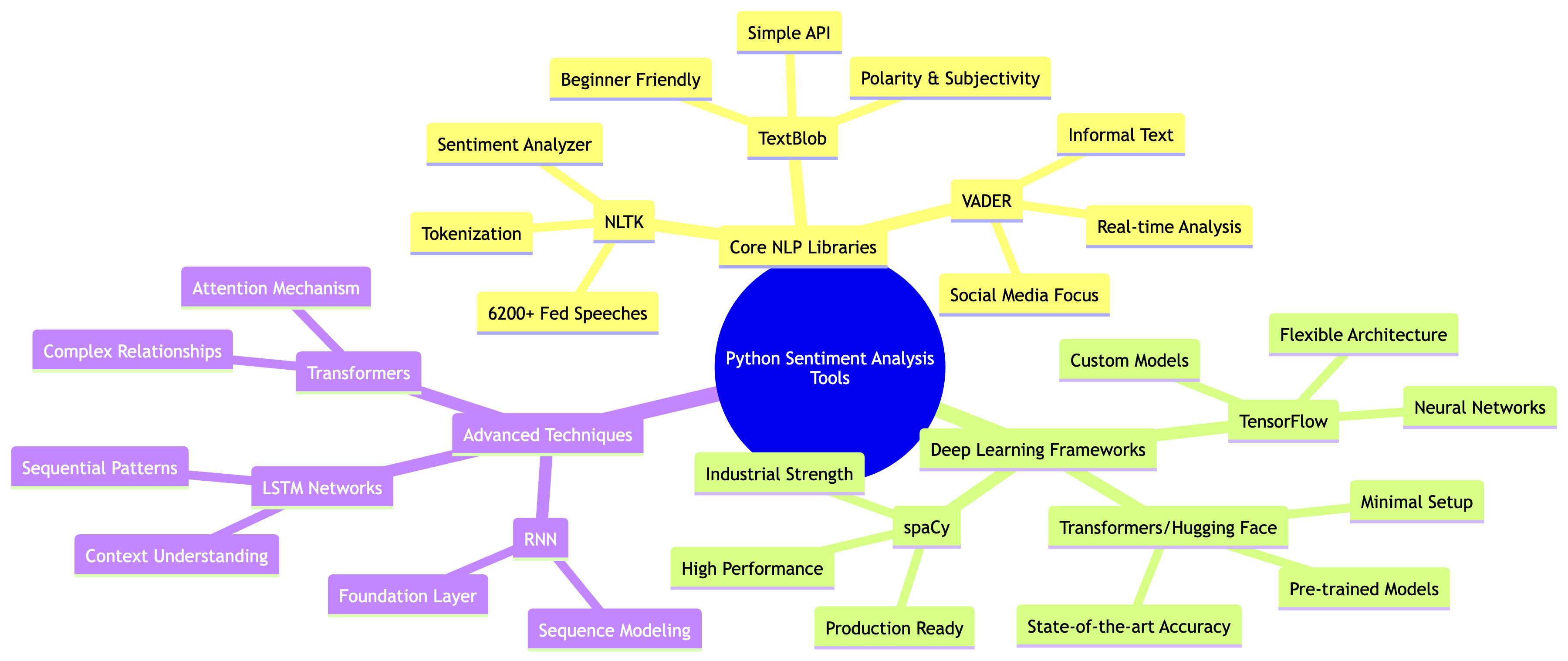
Core NLP Libraries
Text sentiment analysis nltk forms the foundation of many sentiment analysis projects. The Natural Language Toolkit (NLTK) provides comprehensive tools for natural language processing tasks including tokenization, stemming, and built-in sentiment analyzers.
import nltk
from nltk.sentiment import SentimentIntensityAnalyzer

# Download required NLTK data
nltk.download('vader_lexicon')

# Initialize the analyzer
sia = SentimentIntensityAnalyzer()
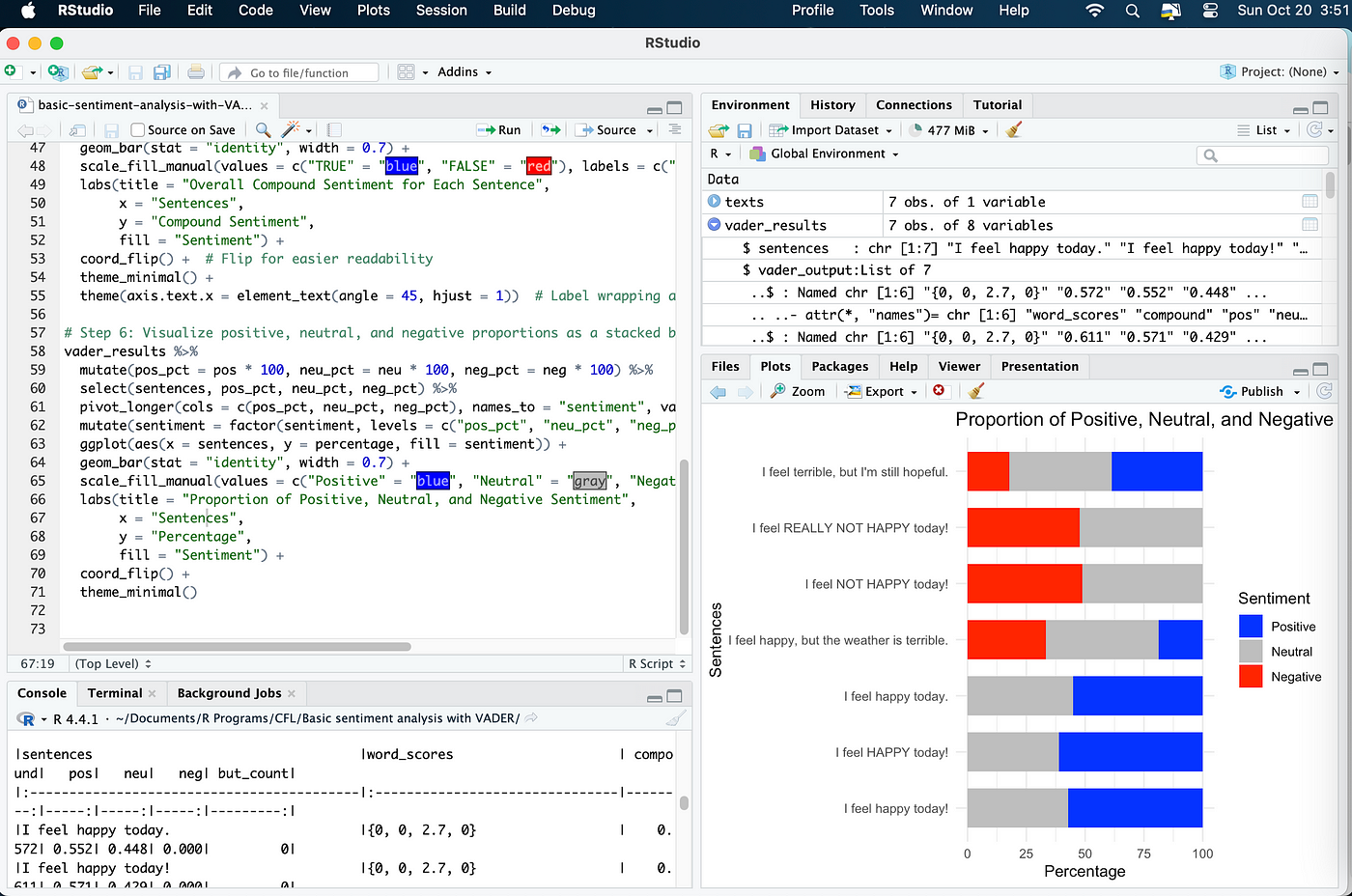
VADER (Valence Aware Dictionary and sEntiment Reasoner) stands out as one of the most effective tools for social media text analysis. The Valence Aware Dictionary contains pre-calculated sentiment scores for words commonly used in informal text.
# Using VADER through NLTK
scores = sia.polarity_scores("This product is absolutely amazing!")
print(scores)
# Output: {'neg': 0.0, 'neu': 0.295, 'pos': 0.705, 'compound': 0.8176}
📌 Key Insight: VADER excels at handling informal language, emoticons, and social media slang, making it ideal for analyzing tweets and social media content.
Simplified Analysis Tools
Text blob sentiment analysis offers an incredibly user-friendly approach for beginners. The Text Blob library abstracts complex NLP operations into simple method calls:
from textblob import TextBlob

text = "I love this new smartphone!"
blob = TextBlob(text)
sentiment = blob.sentiment

print(f"Polarity: {sentiment.polarity}")
print(f"Subjectivity: {sentiment.subjectivity}")
The SentimentIntensityAnalyzer provides detailed sentiment breakdowns, offering granular control over sentiment interpretation.
Advanced Machine Learning Frameworks
TensorFlow enables the development of sophisticated deep learning models for sentiment analysis. Its flexibility allows for custom model architectures tailored to specific use cases.
Hugging Face has revolutionized sentiment analysis with pre-trained transformer models. These models offer state-of-the-art accuracy with minimal setup:
from transformers import pipeline

sentiment_pipeline = pipeline("sentiment-analysis")
result = sentiment_pipeline("This tutorial is incredibly helpful!")
print(result)
spaCy provides industrial-strength NLP capabilities, offering excellent performance for production environments where speed and accuracy are crucial.
Understanding Sentiment Scores
Interpreting sentiment analysis results requires understanding different scoring mechanisms and their implications.
Core Sentiment Metrics
Sentiment_score represents the fundamental output of any sentiment analysis system. Different libraries use varying scales and interpretations:
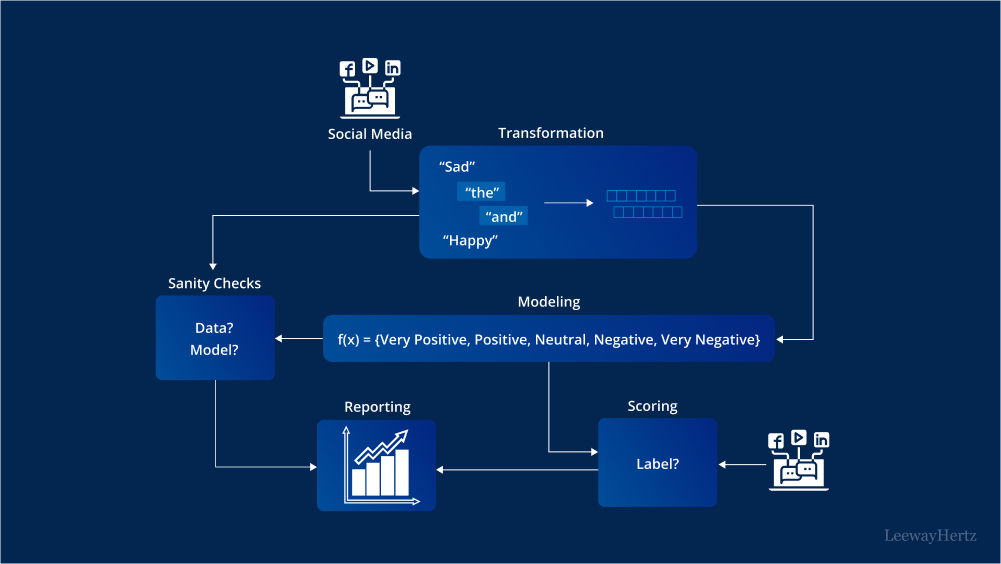
- Polarity score typically ranges from -1 (most negative) to +1 (most positive)
- Compound scores in VADER provide normalized sentiment values
- Subjectivity measures how opinion-based versus factual the text appears
- Objectivity represents the inverse of subjectivity
Polarity Score Interpretation
Understanding polarity score ranges helps in making informed decisions:
| Score Range | Interpretation | Example Use Case |
|---|---|---|
| 0.7 to 1.0 | Very Positive | Highlight customer testimonials |
| 0.3 to 0.69 | Positive | General positive feedback |
| -0.29 to 0.29 | Neutral | Factual or mixed content |
| -0.69 to -0.3 | Negative | Areas needing improvement |
| -1.0 to -0.7 | Very Negative | Urgent customer service issues |
Advanced Score Analysis
Compound scores provide normalized sentiment values that account for intensity and context. These scores prove particularly useful when comparing sentiment across different text lengths or sources.
# Comparing different sentiment expressions
texts = [
    "Good product",
    "Really good product!",
    "AMAZING product!!!"
]

for text in texts:
    scores = sia.polarity_scores(text)
    print(f"'{text}': {scores['compound']}")
⚠️ Important Note: Always consider subjectivity alongside polarity. High polarity with low subjectivity might indicate biased or promotional content rather than genuine sentiment.
Advanced Techniques and Methodologies in Sentiment Analysis
Modern sentiment analysis extends beyond simple positive/negative classification, incorporating sophisticated preprocessing and modeling techniques.
Text Preprocessing Fundamentals
Tokenization breaks text into individual words or tokens, forming the foundation for all subsequent analysis. Proper tokenization handles punctuation, contractions, and special characters effectively.
Lemmatization reduces words to their root forms, ensuring that "running," "runs," and "ran" are treated as variations of "run." This normalization improves analysis accuracy significantly.
import nltk
from nltk.stem import WordNetLemmatizer
from nltk.tokenize import word_tokenize

lemmatizer = WordNetLemmatizer()
text = "The runners were running quickly"
tokens = word_tokenize(text)
lemmatized = [lemmatizer.lemmatize(token.lower()) for token in tokens]
print(lemmatized)
Feature Extraction Methods
BOW Vectorization Approach (Bag of Words) converts text into numerical representations that machine learning algorithms can process. This technique creates feature vectors based on word frequency counts.
from sklearn.feature_extraction.text import CountVectorizer

# Sample text data
texts = ["I love this product", "This product is terrible", "Average product quality"]
vectorizer = CountVectorizer()
bow_matrix = vectorizer.fit_transform(texts)
print(vectorizer.get_feature_names_out())
Deep Learning Approaches
LSTM (Long Short-Term Memory) networks excel at capturing sequential patterns in text, making them ideal for understanding context-dependent sentiment.
RNN (Recurrent Neural Networks) provide the foundation for sequence modeling, though LSTMs generally offer superior performance for sentiment analysis tasks.
Transformers represent the current state-of-the-art in NLP, offering unprecedented accuracy through attention mechanisms that understand complex linguistic relationships.
Advanced Analysis Techniques
Opinion mining goes beyond basic sentiment to extract specific opinions about product features, service aspects, or topic components. This granular analysis provides actionable insights for business improvement.
Text sentiment analysis python code implementation often combines multiple techniques:
# Advanced sentiment analysis pipeline
def advanced_sentiment_analysis(text):
    # Step 1: Preprocessing
    tokens = word_tokenize(text.lower())
    lemmatized = [lemmatizer.lemmatize(token) for token in tokens if token.isalpha()]

    # Step 2: Multiple analyzer comparison
    blob_sentiment = TextBlob(text).sentiment.polarity
    vader_sentiment = sia.polarity_scores(text)['compound']

    # Step 3: Weighted combination
    final_score = (blob_sentiment + vader_sentiment) / 2

    return {
        'text': text,
        'textblob_score': blob_sentiment,
        'vader_score': vader_sentiment,
        'combined_score': final_score
    }
Polarity_scores analysis benefits from ensemble methods that combine multiple algorithms, reducing individual model biases and improving overall accuracy.
Subjectivity score analysis helps distinguish between factual statements and opinion-based content, crucial for applications requiring objective versus subjective content separation.
Challenges and Solutions in Sentiment Analysis
Even sophisticated sentiment analysis systems face significant challenges that require careful consideration and strategic solutions.
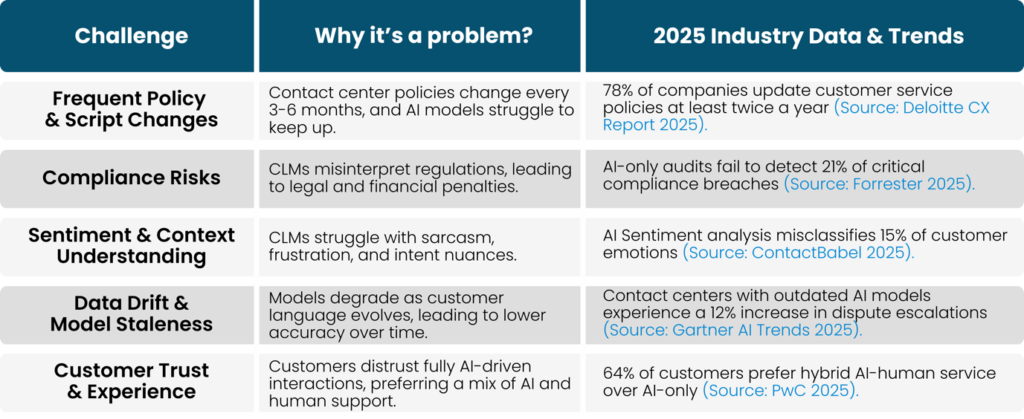
Accuracy and Performance Challenges
Accuracy score variations across different domains highlight the importance of model selection and training data quality. Generic models often struggle with domain-specific language and context.
Training accuracy doesn't always translate to real-world performance, especially when dealing with:
- Sarcasm and irony detection
- Context-dependent meanings
- Cultural and linguistic nuances
The Learning Curve Reality
The learning curve for sentiment analysis involves multiple stages:
- Basic Implementation: Simple polarity detection
- Intermediate Development: Feature engineering and model tuning
- Advanced Optimization: Custom models and ensemble methods
- Production Deployment: Scalability and performance optimization
Common Challenges and Solutions
| Challenge | Impact | Solution Strategy |
|---|---|---|
| Sarcasm Detection | False positive/negative results | Context-aware models, user behavior analysis |
| Domain Adaptation | Poor accuracy in specialized fields | Domain-specific training data, transfer learning |
| Language Variations | Inconsistent results across dialects | Multi-language models, regional training sets |
| Data Quality | Noisy input affects output reliability | Robust preprocessing, outlier detection |
💡 Pro Tip: Always validate your sentiment analysis results with human annotation on a subset of your data to ensure accuracy meets your application requirements.
Conclusion: The Future of Text Sentiment Analysis with Python
The evolution of text sentiment analysis python tutorial methodologies continues accelerating with advances in artificial intelligence and machine learning. As we look toward the future, several trends will shape the landscape:
Transformer models and large language models are setting new accuracy benchmarks while becoming more accessible through cloud APIs and pre-trained models. The democratization of advanced NLP capabilities means that even small organizations can implement sophisticated sentiment analysis solutions.
Real-time sentiment analysis is becoming standard rather than exceptional, enabling businesses to respond to customer sentiment shifts within minutes rather than days. This capability transforms customer service, brand management, and product development cycles.
The integration of multimodal analysis—combining text sentiment with image and video content—opens new possibilities for comprehensive social media monitoring and customer experience analysis.
As Python's ecosystem continues expanding with new libraries and frameworks, the barrier to entry for sentiment analysis implementation continues decreasing. This accessibility, combined with increasing data availability, positions sentiment analysis as an essential tool for data-driven decision making across industries.
Whether you're an academic researcher studying social trends, an SEO technical manager optimizing content strategy, or a product manager seeking customer insights, mastering text sentiment analysis with Python provides a competitive advantage in our increasingly digital world.
People Also Ask
More on Entity Analysis
Proven Google NLP Strategies That Boosted SEO Rankings
Look, if you're still thinking about SEO the way we did five years ago, you're already behind. Google isn't just matching keywords anymore – they're actually understanding what people mean when they…
Google NLP and Search Ranking: The Complete Guide to Entities, Syntax, Salience, and Moderation
Are you still clinging to the old-school, open-book SEO playbook—think Google’s classic guidelines—hoping your content will climb the ranks just by nailing metadata, stuffing keywords, and hitting a…
How text classification powers smarter sentiment analysis
Sentiment analysis and text classification are foundational techniques in natural language processing (NLP) that help systems understand and categorize human language. While sentiment analysis…
Top Sentiment Analysis Tools to Compare in 2025
A text sentiment analyzer is a tool designed to interpret and classify the emotional tone behind a body of text. Whether it's a product review, a customer email, or a tweet, sentiment analysis tools…
Text Sentiment Analysis Guide: Meaning, Methods & Use Cases
Text sentiment analysis is a natural language processing (NLP) technique used to determine the emotional tone behind a body of text. By analyzing text data, sentiment analysis tools help identify…