
GSC Clicks Spiked, Impressions Flat (Nov 2026): Why?
Why Did Google Search Console Clicks Jump on Nov 1, 2026 While Impressions Stayed Flat?
On November 1 we opened Search Console for a client, a major cross-border travel-experience platform, and thought we were having a good day. Clicks were up 24.5%.
Then we looked at the rest. Impressions: up 4.8%. Rankings: flat. Real visits from Google: up 8%. A quarter more clicks, and almost nothing behind them.
If your own GSC jumped around October 31, 2026, this is for you. It is probably not growth. It is what we started calling ghost clicks.
Why did GSC clicks spike while impressions stayed flat?
Short answer: scrapers are clicking Google's results on a schedule, and Google changed how results are delivered, so scrapers now have to click to get what they need. Those clicks count in Search Console. They never reach your site.
Here is the story in three moves.
First, Google started fighting scrapers. In July, Google began testing "goto" redirect links in search results, a way to spot and block automated tools (Search Engine Roundtable). On top of that came more captchas, IP blocking aimed at proxy networks, and a nastier trick: serving suspected rank trackers "poisoned" results with listings swapped out. Nozzle measured it on 8% to 23% of results, peaking near 43% on September 30 (PPC Land, Coywolf).
Second, the tools you rely on got worse. Semrush said it had seen poisoned results "since late summer", though it called the impact on tracked rankings "limited". Ahrefs said on October 22 that 5% to 20% of results were affected, depending on the provider, and that it was cleaning past data. SE Ranking still had about 2% affected on October 16, and SEOmonitor reprocessed its data after wrong results between October 9 and 13 (Circuit). Did Google ban these tools? No. The Roundtable piece describes a crackdown on scrapers in general and says the tools SEOs use are probably not the target. They were collateral damage.
Third, the vendors rebuilt, and that is when the clicks began. On October 26 every benchmarked SERP API broke in the same hour. By October 29 to 31 they had recovered. On October 31, our client's clicks started to climb, and so did clicks on many other sites.
Here is the part we think connects them, and we want to be clear it is our hypothesis. If Google no longer shows the plain destination URL for each result, a scraper that wants to know where result number 14 points has to click Google's redirect link and read where it leads. Google logs that as a click. The scraper has no reason to open your page, so it never loads. That matches what we saw: clicks in Search Console, nothing in the server logs.
| Date (2026) | What happened | Source |
|---|---|---|
| July | Google tests "goto" redirect links in results to catch scrapers | Roundtable |
| Sep 13 to Oct 21 | Swapped ("poisoned") results served to suspected trackers | PPC Land |
| Oct 13 | SEOmonitor reprocesses data after wrong results | Circuit |
| Oct 16 | SE Ranking: about 2% of results still affected | Roundtable |
| Oct 22 | Ahrefs: 5% to 20% affected, cleaning history | Roundtable |
| Oct 26 | Every benchmarked SERP API breaks in one hour | cloro.dev |
| Oct 27 | Semrush statement: poisoned results since late summer | Roundtable |
| Oct 29 to 31 | Vendors recover | cloro.dev |
| Oct 31 | The click spike starts on many sites | Roundtable |
The timing lines up. No vendor has confirmed it, and Google has not confirmed a cause (as of November 6, 2026). We also cannot rule out that Google changed how it counts clicks at the same time. Our best guess is scheduled rank-tracker or AI-visibility jobs, the Semrush and Ahrefs kind. We are testing that now, and the result will be its own article.
What to do today: mark October 31 on your reports and stop reading November click numbers as wins. The full list is at the end.
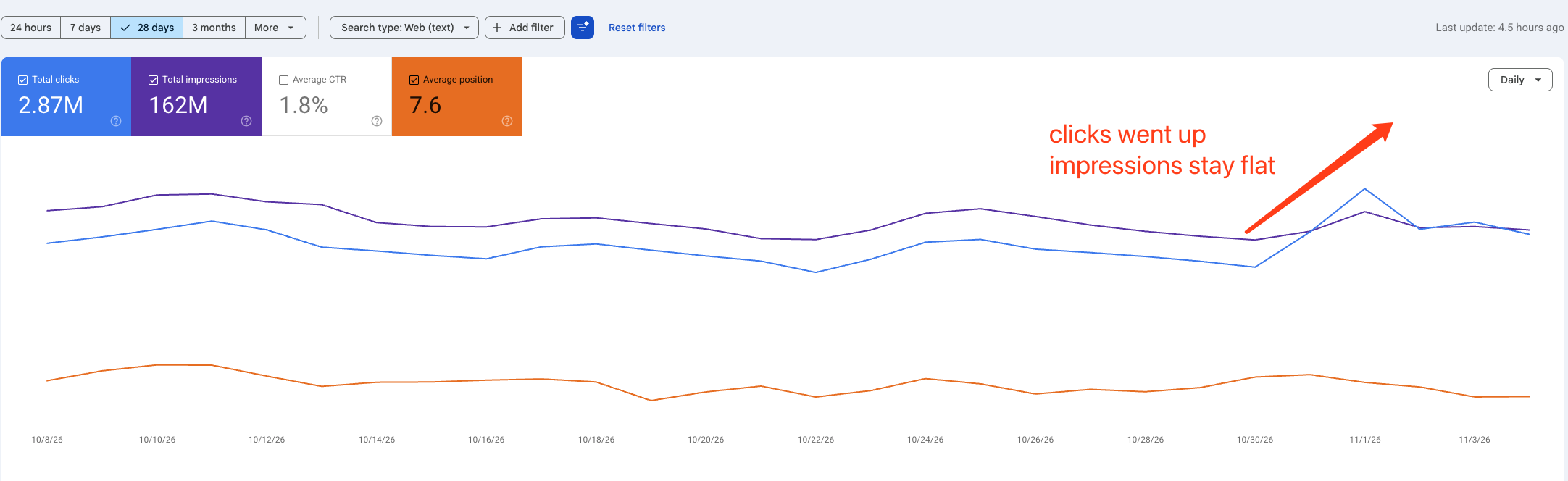 Search Console, Web, 28 days, daily. Blue is clicks, purple is impressions, orange is average position. Clicks jump around November 1 while impressions and average position stay flat.
How do we check whether a GSC click spike is real?
Start with the question that matters: is it a person? We say no, and one look at long-tail clicks is enough.
Step 1: Look at where the clicks land
Real searchers click the top of page 1. Past that, almost nobody clicks. So we looked at click-through by position, before and after.
Position 1 barely moved. Positions 13 to 20 jumped 8 to 12 times. Beyond position 20, nothing changed. That is not how a person searches. That is something reading the first two pages of results and opening several of them.
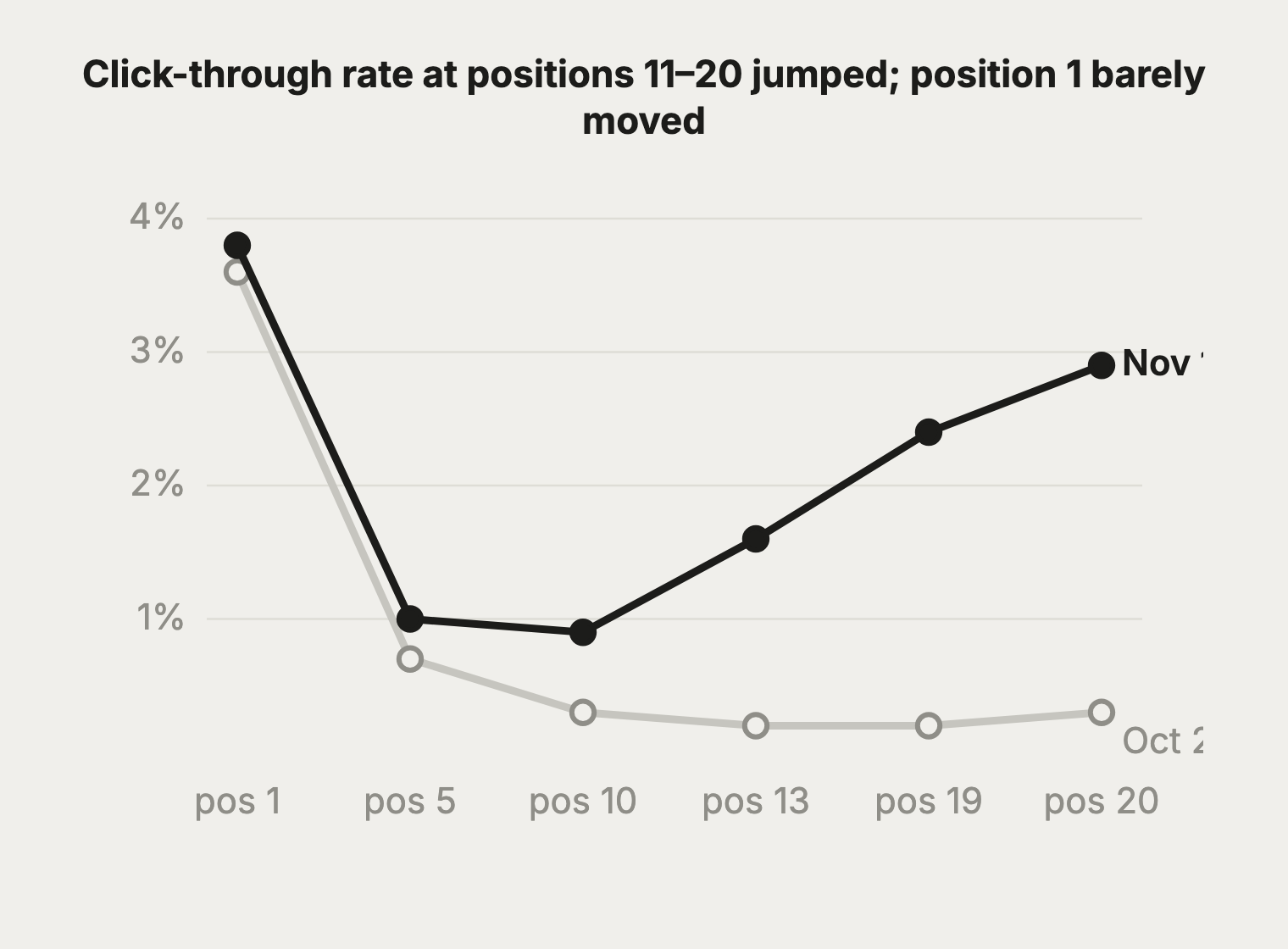 Click-through rate at positions 1, 5, 10, 13, 19 and 20, Oct 29 (grey) and Nov 1 (black). The black line separates from the grey one only from position 13.
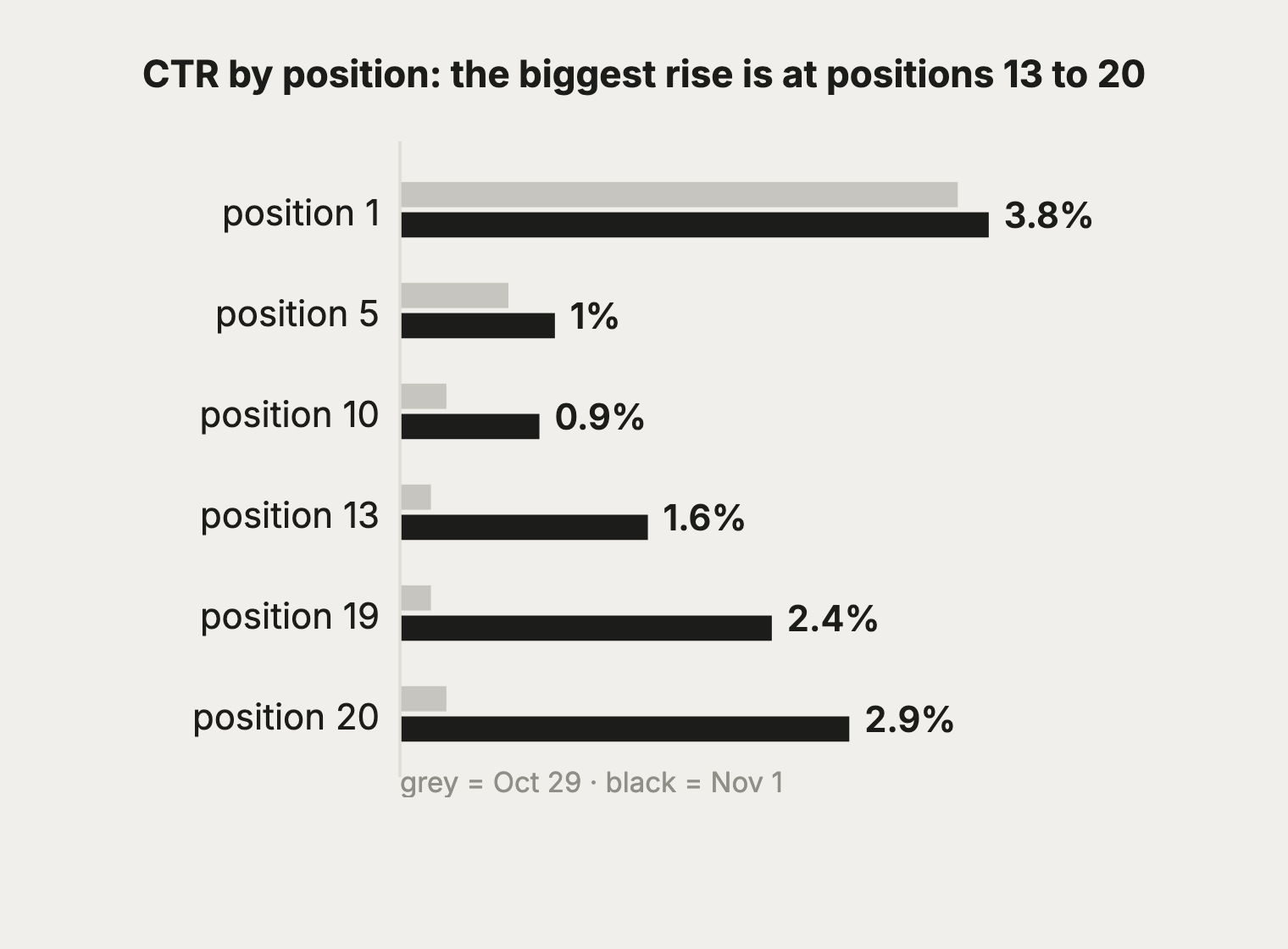 The same data as paired bars: grey is Oct 29, black is Nov 1. Position 1 barely changes; positions 13, 19 and 20 grow 8 to 12 times.
The long tail tells the same story. One-shot clicks on queries with only one or two impressions roughly doubled. Queries where two or more of the client's pages got clicked more than tripled. In some hours, thousands of different queries each got exactly one click. People do not search like that.
Step 2: Check whether the visits exist
If people really clicked, visits must follow. We compared three tools, because each one sees a different step of the click path.
GSC counts what Google logged: up 24.5%. Cloudflare counts who reached the server: real human visits from Google up 8%. GA4 counts who ran the page scripts: Google-referred sessions up about 14%. A real spike shows up in all three. This one shows up in the first.
Then we built a control group: pages whose clicks did not change. A normal page brings about 16 visits per GSC click, because the count includes pages Google preloads. On the pages that suddenly gained clicks, each click brought about 2 visits. One eighth of normal. One Japanese blog page went from 0 to 136 clicks and had no human visit at all.
Step 3: Rule out Google and the AI agents
Next question: could it be Google's own crawler, or an AI agent fetching pages for users? We checked.
In Cloudflare's crawler logs, the share of clicked pages that Googlebot also fetched in the same hour went down after the spike, from 9.7% to 7.9%. Google's browsing agent fetched only a few dozen of the clicked pages and never arrived through a Google results link. ChatGPT-User, Claude-User, Perplexity-User, Grok, Manus and Meta's Muse were flat.
We even tested Grok with a marked URL on November 6. It fetched the page through Exa's fetcher from a US data center, with no referrer and no scripts. Grok does not search Google, so it is not the clicker.
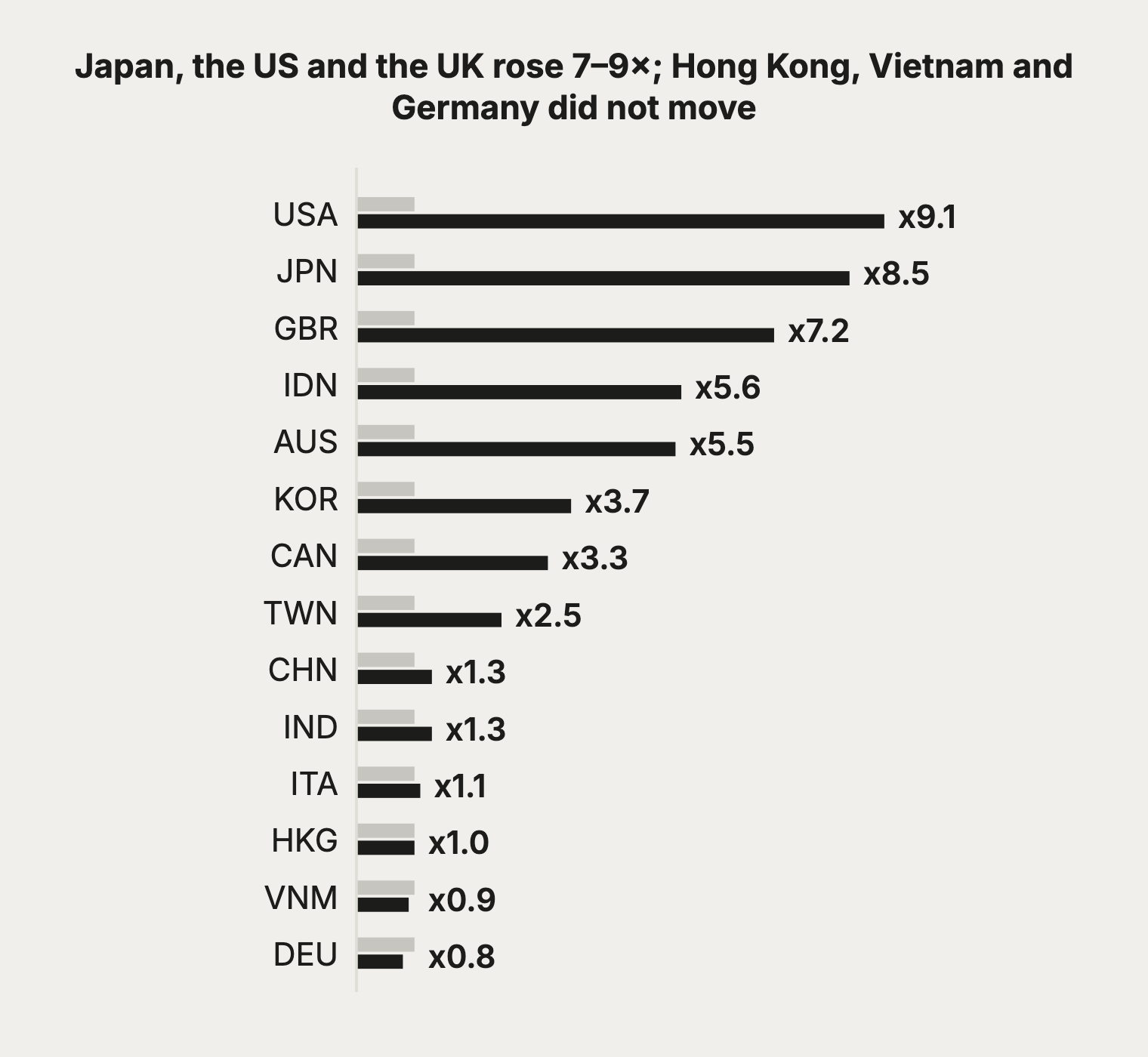 Deep-click multiplier by country, before and after Oct 31. The grey stub is the baseline (1.0), the black bar is the multiplier. Hong Kong, Vietnam and Germany did not move.
The country footprint helps too. Deep clicks (position 10 and below) rose 9.1 times in the USA, 8.5 in Japan and 7.2 in the UK, while Hong Kong, Vietnam and Germany stayed flat. Page language does not decide it: searchers in Taiwan clicked pages in the Hong Kong language version, searchers in Hong Kong did not. That makes Hong Kong a clean control market.
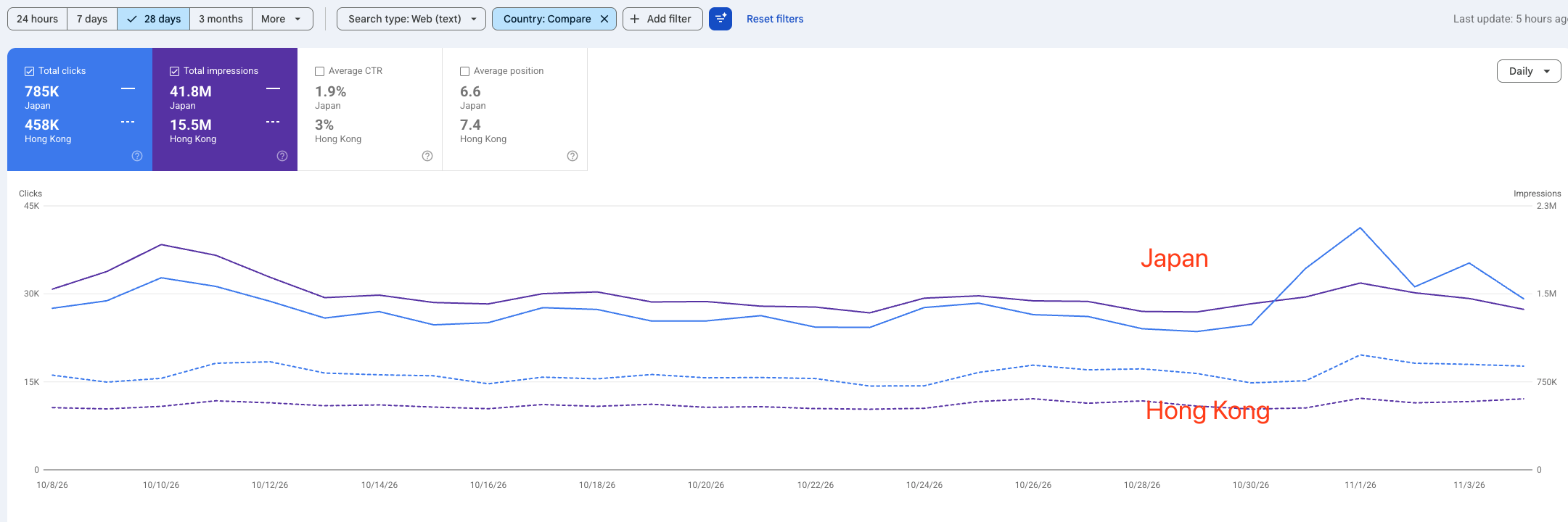 Search Console, Web, Japan (solid lines) against Hong Kong (dashed lines). Blue is clicks, purple is impressions. Japan's clicks spike around November 1 while its impressions barely move. Hong Kong's clicks rise far less.
Step 4: Narrow it down to scheduled scrapers
So not a person, not Google, not an AI assistant. What is left? Something that runs on a schedule. Our first guess was people with an AI browser agent, because excess clicks in Japan and Taiwan followed local working hours. The hourly data corrected us.
We compared hourly clicks by country and device, in UTC, for Japan, Taiwan, the USA and South Korea, with Hong Kong as the control. Three things stood out.
The bursts are sharp one-hour spikes. Japan desktop clicks hit 30 to 81 times the normal level at 19:00 to 20:00 UTC on October 31. People do not click like that.
Several markets burst in the same hour, but only about five times. On November 3 at 12:00 UTC, US desktop was at 39.4 times its normal level for that hour, Korea desktop at 9.6, Japan desktop at 7.0 and Taiwan desktop at 3.3. Hong Kong stayed under 2.5.
And most bursts hit only one market. Japan desktop burst alone on several hours of November 1 and 2, while the US, Korea and Taiwan stayed normal. US desktop burst alone from October 31 at 23:00 UTC to November 1 at 03:00.
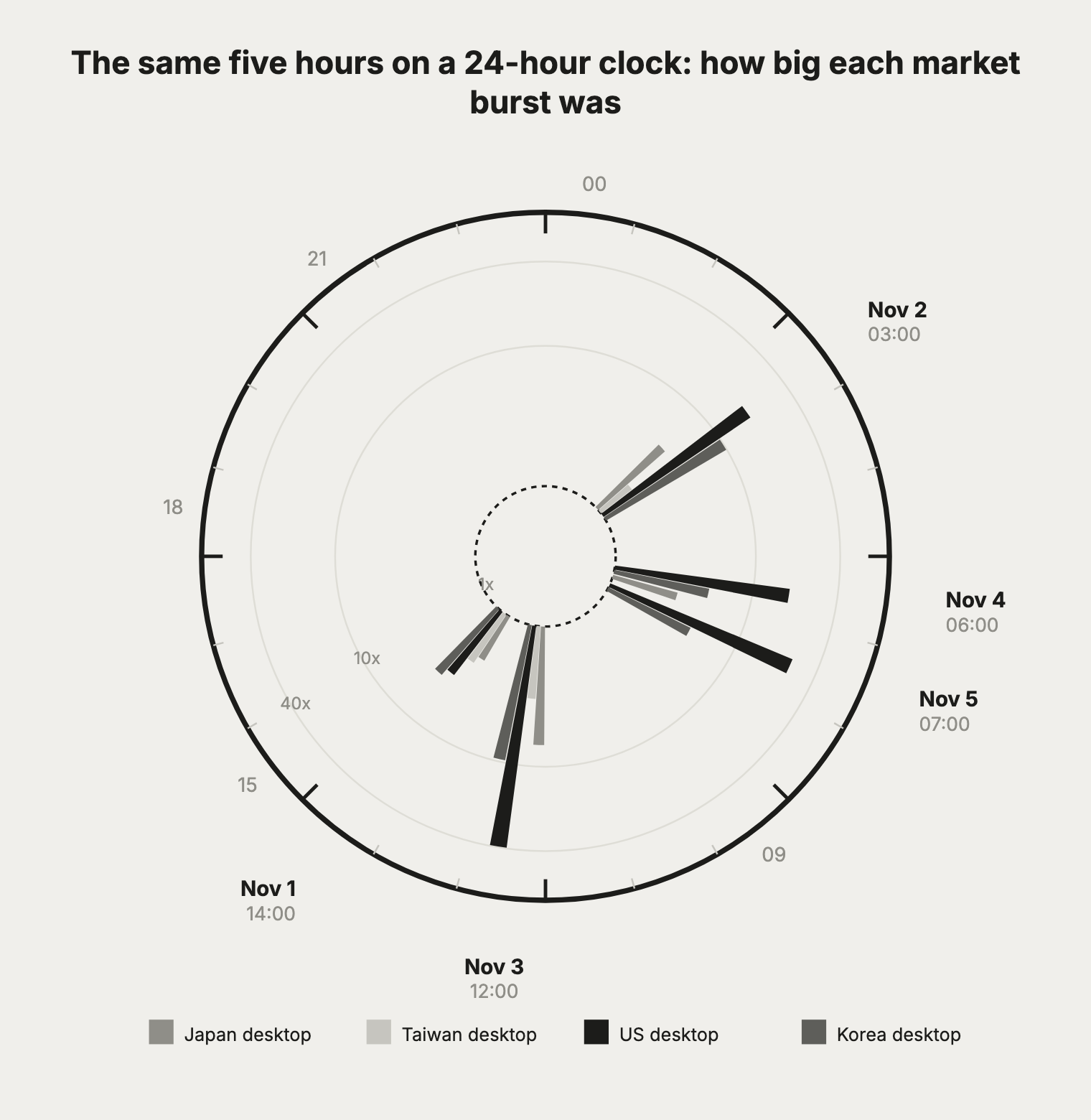 The five shared burst hours on a 24-hour clock in UTC, 00 at the top. Each of the five spokes is one hour; its four bars are Japan, Taiwan, US and Korea desktop. Bar length is the multiple of the same hour on Oct 29–30, on a log scale (dashed ring = 1x, then 10x and 40x). Taiwan has no bar on Nov 4 and Nov 5 because it stayed below 2.5x. Hong Kong never burst and is left out. The five hours fall at five different times of day.
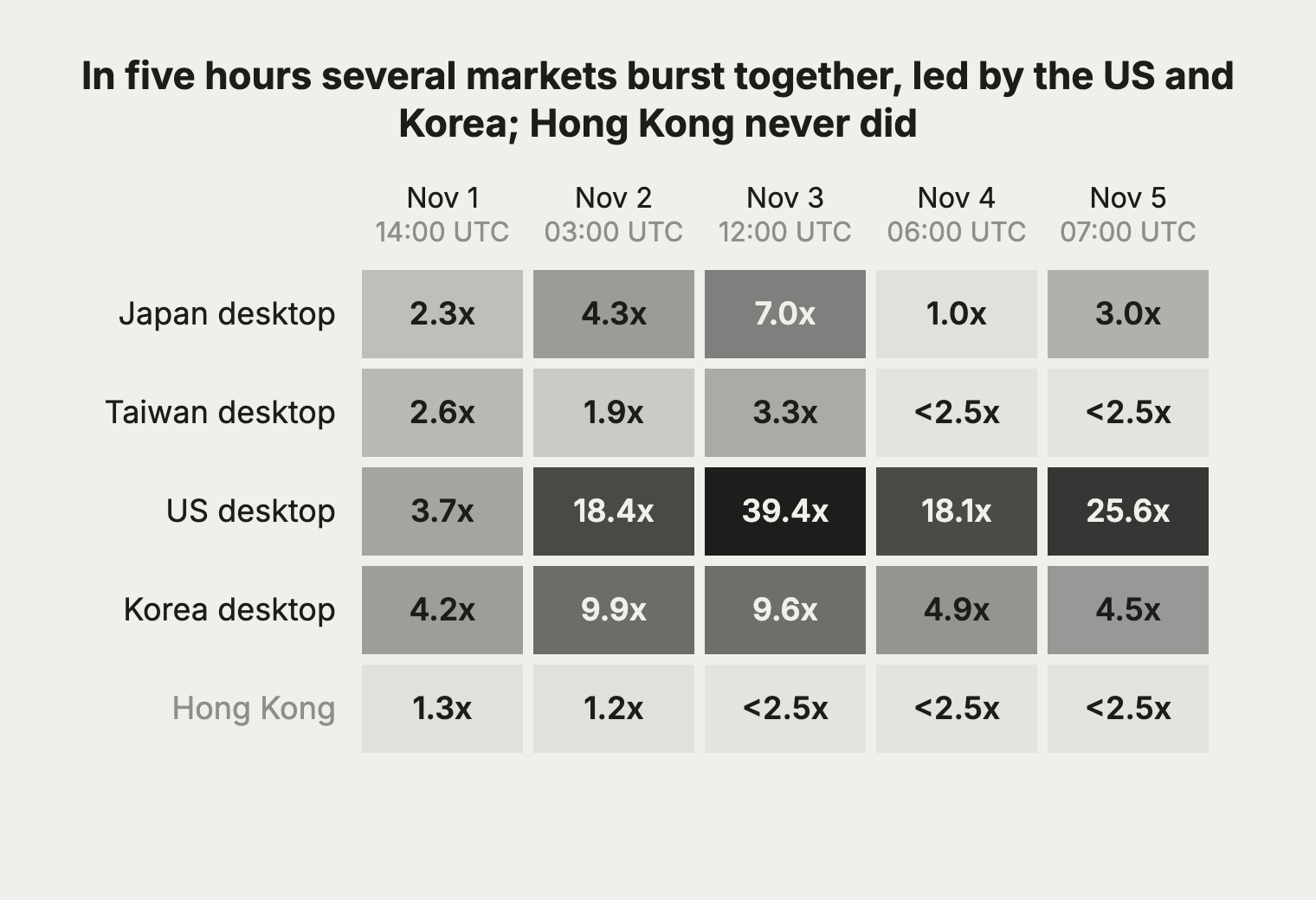 The same five hours as a table: clicks as a multiple of the same UTC hour on Oct 29–30. Darker means a bigger burst. "<2.5x" means the hour stayed below 2.5 times. Hong Kong, the control, never burst.
In all five shared hours the US and Korea were well above normal, US desktop between 3.7 and 39.4 times and Korea desktop between 4.2 and 9.9 times. Japan was at 2.3 times or more in four of the five hours, Taiwan at 2.6 times or more in two.
Our reading: a schedule, not people. But not one single batch either. It looks like one multi-market run about once a day, at a different hour each day, plus separate runs that hit a single market. That fits several tracker jobs, or several vendors, running at once. The top-20 cut-off fits as well: rank trackers collect only the top 20 since Google removed the num=100 results setting in 2025.
How can a click be logged when the page never loads?
The redirect-link route above is the one we favor. Three other routes would leave the same footprint.
The click can be logged before the browser leaves Google, so if navigation stops, the click still counts. Scrapers that run a browser through paid proxies can block every request that is not to Google to save bandwidth, so the click goes through and the trip to your site does not. And Google may have relaxed its click filter at the same time, counting clicks it used to drop. Our data cannot separate these routes from each other.
One thing none of them explains: Hong Kong and the EU did not move. With the burst pattern, that fits several tracker jobs or vendors rather than one batch.
What is the result of our tracker test?
I will show the result later, when the test is finished. We set it up yesterday, and GSC needs 2–3 days before the data comes back, so there is nothing to report yet.
The design is simple. We added a few obscure query and page pairs (position 11–20, zero clicks before) to a rank tracker, Ahrefs first, then Semrush and an AI-visibility tool if needed. After each tracker run we check GSC hourly clicks for those queries and Cloudflare requests to the page. If GSC shows clicks and Cloudflare shows no visit, the tracker is confirmed as a source. If GSC shows nothing, that vendor is not a source and we test the next one.
What should site owners do about it now?
Treat the spike as a measurement problem, not as growth.
- Mark October 31, 2026 on every GSC report. Treat the extra clicks as clicks without visits until Google comments.
- Report a clean click series next to the raw one. Exclude rows at positions beyond 10 with very high click-through, and one-or-two-impression rows with 100% click-through. Keep the raw series visible.
- Use a control market. Hong Kong did not move, so its click trends stay valid. Compare other markets against it.
- Report real human visits from Cloudflare as the visit number beside GSC clicks.
- Re-check the position and country patterns weekly. If the list of affected countries changes, you learn about the rollout.
- Tell your SRE or cloud team that Google's own crawler traffic rose sharply in early November too. It does not explain the clicks, but someone should look.
What not to do:
- Do not report the October 31 to November growth as SEO growth or a click-through win.
- Do not block Google's crawlers or the AI assistants. They are not the cause.
- Do not try to filter it with firewall rules. The clicks are logged on google.com and never reach your site.
- Do not use November 2026 click-through to judge title or meta tests in the affected markets.